Ad

Planning to build a yurt in Czech Republic

Ok, but if I make the door frame higher, it will affect the whole yurt shape, won't it? It would then ask for different wall tarp and the roof would be assymetrical, or do I miss something? I'd love to have the door taller, but don't see a way to do it, unless I distort the overall shape of the building.
But, I may actualy make the walls higher than I planned. Guy from the lumber shop that makes the laths for me called, saying the laths will be ready this week, though they'll have to charge me for 3m laths (I need 2,2m only), as they only make small orders in this length. It wasn't too much money, so I didn't care, but perhaps I may not even shorten them and just make the khana higher.
 
Last edited:
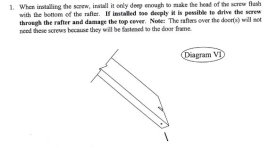
I dunno if this matters or not because I don't build these things, but on my Pacific Yurt, they join the cable ends right above the door. There is a slot that receives the cable on the end of each rafter. Once you set the rafters in place, your run a screw through the width of the rafter, on its end, behind the cable, blocking it from coming out of the slot. I hope that made sense lol.
 
Thanks, it's an interesting solution, but it seems to me like that way the cable doesn't really help the walls much, as it hangs on the rafter ends...but maybe I'm wrong. Or does your yurt have the rafters laid straight on the cable between the wall lath crosses? I saw some modern yurts had that, but I'd rather use the classic way and lay the rafter on the crossings.


I'm just back from town, been at couple hardware and builder's shops. Have a 5mm coated steel cable with some clamps and some supplies for the crown ring construction (wood screws, construction PU glue and such).
 
Jafo, you have a solid yurt.

Knecht, if you have the option of building a taller wall, go for it. That would make the yurt appear more symmetrical and less like a hobbit house. lol My wall is about 5'4". I wouldn't want it any lower.

As for dealing with the cover at the door, I suggest you make a two piece cover since it is WAY easier to make. A two piece cover easily adapts to the door frame being taller than the wall, as does using a tarp for the roof.

I covered my yurt roof with a tarp. I cut out a pie shaped segment and restitched it so it fits tightly to my roof pitch. I stitched loops on the perimeter of the cover all around the outside edge. The loops laying above the entry door frame are roped to the frame and around the rfaters above the frame. The door frame could have been a half foot taller and that would still work fine.


As for the wall cover, I added loops to the top edge of the wall cover at the lath crosses and simply drape it over one leg of the cross. The loops are just big enough to fit over a single lath. That keeps the wall cover up high.

The wall cover loops get trapped in place when I tie off the cable and rafters. Works great. I also stitched loops into the edge of the wall cover at the door frame. I rope the wall cover at the door frame to small screw eyes embedded in the frame.

There are much better systems than mine though. Mine is solid as heck, but vary rustic looking. Who'd pay for that? lol Hopefully someone else will comment here. Gotta go to work. Later.
 
I'm self employed, so one last comment, then then work lol. What I said about Mongolian yurts frequently having door frames higher than the wall isn't true. I just googled Mongolian yurt pics on 'images'. None had a door frame higer than the wall. The wall and the door frames match in height pic after pic. My yurt is an odd ball. WAAAHHHH!!! lol

Later.
 
I'll do the math tonight and see how tall walls would the longer laths allow me. Then I'll decide whether or not make the door frame higher.
Thanks for all your advice and information Bob, it's all very helpful.

I have the 4 large parts of the crown cut out, now making the 8 smaller ones. Still handtools (still testing 4 pocket saw models), just used electric sander to grind the flat surfaces.
 
Ok, finally some progress: got the laths today, both for roof (right) and khana (left).

 
I suggest making a pattern out of a single wall lath. Take the time to make dead certain you have the centers correct. Bore your holes. Mark it 'pattern' on both sides. Use it to transfer marks to the others. That way there are no math and tape reading errors. Using a pattern you no for certain is correct puts you at ease during the layout.

I also suggest you consider having your start and end holes match in length from the end of the lath. For example, mine are 3" from either end. With the holes close to the end, the unsupported section of lath is less likely to break due to a knot or from getting banged around during erection and dismantling. When you build the wall you don't have to mess around with 'which end goes up'.

Have fun.
 
Yes, I plan to make a pattern lath, then maybe some sort of "fence" to lay the laths(s) in a fixed position with a pattern one on top and drill them without worrying if any of them have moved.
Today's photo, we stained the laths with a rusty-red wood stain. We worked after sunset on this, as during the day we build my new smithy.

 
The color is more rusty/orange in daylight and after drying. We may do another coat of staining yet if we have enough time.
Today I worked on the ring. All clamps removed and the roughly-cut wooden sandwich brought to shape.

Here's the starting point. Those thick planks I used are at least 30 years old, so I hope they won't crack or twist anymore. They also got dirty over the years, when serving as a workshop shelf. I sanded and cleaned the glued surfaces before joining them, now for the outer ones. You can also see I left generous reserves on material at the edges. It all had to go now.


Trimming the outer edge with my trusty axe.


And now for some sanding.


First sanding session done. Flats and outer edge are +/- straight. The inner edge needed some saw attention yet.


Inner edge cut and ready for tomorrow's sanding and final shaping. Filling the imperfections with epoxy.


Have to say, making wheels is surely not easy! Been the first time I tried making something like that, as you can likely see. But everything feels solid and after I add some wood screws, I believe it will hold securely.
 
No, I plan to make holes for the rafters. Following the traditional way in this. Also surely going to have the ring supported by two vertical posts, so I believe it will withstand the weight and stress.
 
I don't know a lot about building. I always tend to overdue it when I make any attempt at carpentry, mostly because I am not confident about my skills. Hence my 600 pound outhouse that the average carpenter could have made 200 pounds. However, I think you could really sure up that ring if you put a layer of plywood on one or both sides. Something that can handle moisture too btw.

I just am a little worried about all those cut pieces dealing with the stresses of a roof.
 
Knecht, I'm concerned about your ring. Flat laminated rings made from 2X segments typically have 3 layers, not two. I think it's a good idea to buy another board and add a third layer. Or as Jafo said, add a plywood ring top and bottom. Then that ring would approximate the kaminari ring minus the slots, and I know that is an extremely strong ring.
 
Well, I'm planning to add a wider plywood ring on top, to go over the roof tarp center hole's edge, as I wrote couple posts back. Not sure if both top and bottom extra layer are needed. I mean, if I had the center unsupported, I'd surely be concerned about extra strength of the ring. But with those two "bagana" supports, I believe most of the stress and weight is directed to them and the roof rafters no longer put too much prying on the ring. Am I wrong about this, for some reason? I'm not a builder and never had a yurt, so I can surely make mistakes.
Here's the top wide board I plan to add to the ring:


The ring in the above photo sits atop the 2 layer ring you made? You shouldn't be needing to do any mortising? I'm confused. lol

I'm not there seeing what's going on. But no need to explain. I'll trust your judgement. Putting supports under the ring is good.
 
The above photos show the extra rim around the top edge of the ring that I'm planning to make.
Anyway, I was thinking about it and maybe I have a solution. Need to think about it yet.
 
Back
Top