Ad

Yurts and energy consumption (Firewood)

jo17

New member
Hello everyone,

I am near completing my 2nd winter in a wonderful 30' Pacific yurt in Southern British Columbia. Wondering if you may be able to chip in on my winter setup and help improve/lower my wood consumption.

Some details to paint the picture, the yurt is heated by a Neostone 2.5 wood stove. This stove weighs is at a hefty 460 lb' of stove + 370 lb's of soap stone wrapped around it as a heat sink. This stove is rated to heat large spaces, I cant remember to exact sqftage but I believe it was double the sqft of the yurt.

The platform of the yurt is insulated with r22 insulation which is under 3/4 t+g plywood. The yurt has Pacific yurts insulation kit on the walls and celling and three doors at 12 o'clock, 3 and 9.

I have a kitchen sink inside the yurt but the shower and bathroom are in an outbuilding so water vapour inside the yurt is quite minimal.

The winter temps here do go below 0 but often only over night or sometimes for a week or 2. Snow amounts seen to increase each winter and so does the cold.

Ive been burning dry Fur wood mostly with some maple, the issues is I seem to burn though around 6-7 cords a winter which seems considerable to me and what the acreage I live on can sustain.

The stove runs like a champ, Im pretty seasoned on wood stove operations. The stack comes out the top, up 24" then 90s back and out of the yurt. I have had some creo build up at the very top but its normally if I have dampened the stove down to much trying to get a long burn and I've learnt my lesson.

The temperature in the yurt is aways fluctuating a bit but in general it is in-between 18c (64f) to 25c (77f) at head height on the main floor, the sleeping loft is of-course always warmer. Is this above the temperatures other yurt dwellers try to maintain?

I do use a fan on the ceiling to create air flow, on cold nights I hang a wool blanket under the doom and this helps a lot and I also cover the door with micro fibre sheets to stop drafts. In addition I added a strip of insulation around the top edge of the platform where the canvas comes over, this created a seal around the walls of the yurt to stop drafts.

Covering the doors seems to be an issue as the plexiglass condensates considerably.

Is this just par for the course or is there a way to improve this?

I have researched a lot regarding adding insulation the Pacific yurts and I am not closed to the idea but am very aware of vapour barrier issues, mold and losing the beautiful celling display.

I love living in my yurt but also consider budding a cabin some days when I think about the insulation qualities that can be built in easily.

Many thanks in advance.
 
Last edited:
The yurt has ...... three doors at 12 o'clock, 3 and 9.

No additional windows?

How often do you open the doors for ventilation while your´re heating?

Do you open your dome for ventilation too?

Covering the doors seems to be an issue as the plexiglass condensates considerably.

To me, it kind of seems like a mismatch of ventilation and heating.

A sufficient supply of fresh air is very important for the indoor climate. Incorrect ventilation and heating or very strong insulation prevent an automatic exchange of humid air.

In order to ensure adequate air circulation in winter, you have to be careful not to set the heating too high. Wet windows come about when the yurt is in a tropical climate of hot and wet.

Maybe you should try to solve first the condensation issues and second focus to reduce the consumption.
 
Do you have the ability to put in an outside air kit, which supplies combustion air to the stove from the outside via a pipe, rather than through windows, doors, cracks, etc.?

Is it a catalytic stove? I use one called the Ideal Steel stove that gives me long burns when I engage the catalyst:

https://www.woodstove.com/ideal-steel-hybrid-wood-stove
 
I use one called the Ideal Steel stove that gives me long burns when I engage the catalyst:

https://www.woodstove.com/ideal-steel-hybrid-wood-stove

Some questions about:

In the technical details is stated:

BTU Output: 9,323-43,263/hr (per EPA cord wood 2020 tests)

I´ve some problems to understand the correct performance of this stove and to convert the BTU into KW (https://www.rapidtables.com/convert/power/BTU_to_kW.html) for comparison.

How many Sq Ft do you heat and in which climate zone (https://learnmetrics.com/heating-btu-calculator/) is your Yurt located?

Which impact on wood consumption has the catalyst from technical side. I always thought, that it is only for reducing emissions. :confused:
 
i like Jacob idea of a supply air to the stove, which should be easy to do.. I think if we stayed at our Yurt full time we would go through 5 cords and ours is a 24’ in New Hampshire. your walls probably have R-1 insulation value, and that is a lot of surface area with minimal insulation.. good luck !
 
Adding an exterior air supply to the stove is an excellent idea.

That's a reasonable amount of wood for a yurt that size, and in that climate. Consider a yurt is a tent covered with cloth. No yurt is capable of holding heat as well as a house. Scientists in the arctic don't choose yurts as their primary living quarters. :D

FWIW I've read that folks living in log cabins way up north can put up 20 cords a year, heating substantially less square footage.
 
Scientists in the arctic don't choose yurts as their primary living quarters. :D

But the autochthones (like the Nenets....) are doing that with Yurt similar tents (chums) till -70 degrees Celsius.... :p

nenet-siberia-mya-or-choom-3-1200x674.jpg
 
How many Sq Ft do you heat and in which climate zone (https://learnmetrics.com/heating-btu-calculator/) is your Yurt located?

Which impact on wood consumption has the catalyst from technical side. I always thought, that it is only for reducing emissions. :confused:


709 sq ft, 30' diameter yurt with tall walls. It is located in northern central NY in the Tug Hill region where it frequently falls well below zero (-27F yesterday) and several feet of snow each year.

The stove reduced my wood usage dramatically. I use about a 1/3 of the wood I used to. The catalyst ignites the exhaust that would otherwise be emitted and that heat is is captured by the stove and therefore radiated out to the room.
 
The catalyst ignites the exhaust that would otherwise be emitted and that heat is is captured by the stove and therefore radiated out to the room.

Thanks for the explanation. :cool:

I need to familiarize myself in detail with how a catalytic converter works over the next few days.
Until now, I was of the opinion that the polluted exhaust air flows through the catalytic converter and the filters inside it just retain certain parts of the exhaust gases.

The situation, that the catalytic converter itself ignites exhaust gases and thus generates heat, which in turn can be used, is new to me - but I'm happy to learn. :D
 
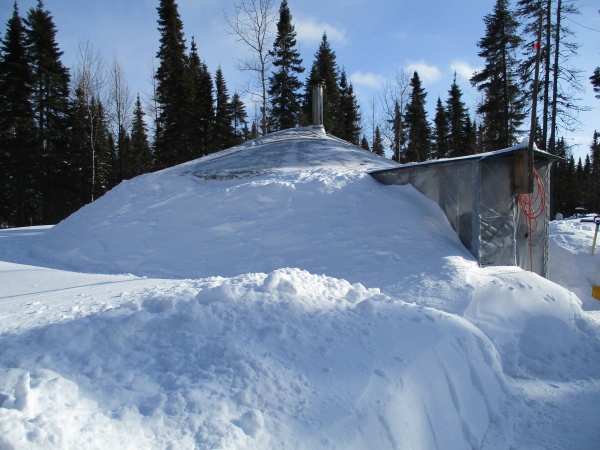
I'm in Northern Ontario and have lived in a 22ft Groovy Yurt for 6 years. We average 4.5-5 bush cords per winter. 70% of that is spruce, 20% poplar and 10% birch. There is a very noticeable difference when we have a good berm of snow up against the walls. Wood consumption drops considerably.

1056-albums97-picture1728.jpg
 
Thanks for the explanation. :cool:

I need to familiarize myself in detail with how a catalytic converter works over the next few days.
Until now, I was of the opinion that the polluted exhaust air flows through the catalytic converter and the filters inside it just retain certain parts of the exhaust gases.

The situation, that the catalytic converter itself ignites exhaust gases and thus generates heat, which in turn can be used, is new to me - but I'm happy to learn. :D


It would be properly termed a catalytic combustor


https://www.woodstove.com/what-is-a-hybrid-wood-stove
 
It would be properly termed a catalytic combustor


https://www.woodstove.com/what-is-a-hybrid-wood-stove

Thanks, @Jafo , that helps a lot for better understanding. :cool:

I made yesterday an technical request directly to the manufacturer and will share the results, as soon they give more detailed information.
Additional I opened the theme in an "German-Stove-Forum" where some absolutely specialists are present and will keep you updated with their views too.

Unfortunately your stove will not be allowed to be operated in Austria, because the efficiency with 77% doesn´t reach the requirements of 80%. :(
 
Zelig.

Berm?!? No disrespect, but I’d say you are 1/2 way to igloo territory! Lol. Awesome though. Maybe that is something to consider when designing a yurt in cold areas, a lower platform.

I’ve said it in many different threads on this forum, I think living in a yurt, it’s best to just be prepared to insulate yourself. Pick up down jackets at the thrift store, wear hats and top notch slippers. (In the spring I clean out the wood box and store all that winter stuff: boots, jackets, sleeping bags in the wood box). Many a day I will go from 2 down jackets in the AM to shorts by noon once the sun is out and things warm up. The stove gets going. But it does take hours. We’ve been experiencing temperatures in the -15F range at night, then warms up to mid twenties and warmer during the day.

Since living at the yurt, I’m also experimenting with whatever happens to ones body when it “acclimates” to cold. I’m wondering if - much like “too clean“ may produce auto immune issues and this intermitting fasting thing being just what the body needs (who knows, look how the “fat causes heart disease” idea turned out). But I do wonder if the constant climate control we so desire, is negatively affecting us in some way. If, perhaps, folks who never give their “temperature acclimation system” a work out, do suffer in some way. Look at the sauna/rolling in the snow behavior - in countries often rated as some of the happiest. Causation or correlation?

Just something to consider when working hard and/or going broke to keep one’s yurt at a constant comfortable temperature. Maybe try backing off a bit. Don’t get up and feed the stove, sleep and deal with it in the morning. Saves wood and you sleep better. It’s truly amazing how there will be a couple 25 degree mornings and the next day 42 feels down right warm. All I know is I’m happy all winter and my friends living in houses are all complaining. ��*♀️

Oh and wood not seasoned properly, does not heat well. It’ll burn, but not throw off much heat. You can’t burn “wet” wood and be warm. Can be very frustrating and confusing.
 
Zelig.


Since living at the yurt, I’m also experimenting with whatever happens to ones body when it “acclimates” to cold. I’m wondering if - much like “too clean“ may produce auto immune issues and this intermitting fasting thing being just what the body needs (who knows, look how the “fat causes heart disease” idea turned out). But I do wonder if the constant climate control we so desire, is negatively affecting us in some way. If, perhaps, folks who never give their “temperature acclimation system” a work out, do suffer in some way. Look at the sauna/rolling in the snow behavior - in countries often rated as some of the happiest. Causation or correlation?

.
This is a brilliant observation. Comparing it to fasting is probably appropriate. I see a lot of people going from a room-temp house to a pre-warmed room temp car, rushing into their room temp office and then returning. Occasionally they are forced to spend an extra minute or two in between climate bubbles and that's when they complain about how cold/hot it is. I try to snowshoe our land every day. Our new neighbours have 5.5 acres and only venture between their door and their driveway. Why do they need the other 5.49 acres?!
 
So - I now have more information on the stove from @Jafo and its technical explanations.

Here in advance some links, to download PDF's, from which experts can certainly draw their conclusions:

Cataltyic-Combustor:
https://www.woodstove.com/image/cat...-Soapstone-Ideal-210a-Cataltyic-Combustor.pdf

Specifications:
https://www.woodstove.com/image/cat...-210a-Approvals-Dimensions-Specifications.pdf

Manual:
https://www.woodstove.com/image/cat...tock-Soapstone-Ideal-210a-Complete-Manual.pdf

Operation:
https://www.woodstove.com/image/cat.../Woodstock-Soapstone-Ideal-210a-Operation.pdf

Installation:
https://www.woodstove.com/image/cat...odstock-Soapstone-Ideal-210a-Installation.pdf

Maintenance:
https://www.woodstove.com/image/cat...oodstock-Soapstone-Ideal-210a-Maintenance.pdf

Safety:
https://www.woodstove.com/image/cat...ual/Woodstock-Soapstone-Ideal-210a-Safety.pdf

Troubleshooting:
https://www.woodstove.com/image/cat...tock-Soapstone-Ideal-210a-Troubleshooting.pdf

Parts-List:
https://www.woodstove.com/image/cat...-Soapstone-Ideal-210a-Parts-List-Diagrams.pdf

Certification:
https://www.woodstove.com/image/cat...dstock-Certification-Letter-278-20-082120.pdf

EPA-Test:
https://www.woodstove.com/image/cat.../Rap_EPA-wood-stove-ALT-125-PI-20234-NCBI.pdf

Woodstock-Soapstone-Ideal-210a-Air-Ventilation.png


For me currently it looks like, that this stove is really an good choice (beside the fact, that its efficiency doesn´t meet the regulations in my country), but I´ll wait with my final conclusion till the stove specialists in the before mentioned German-Stove-Forum are putting their thoughts.
 
I see a lot of people going from a room-temp house to a pre-warmed room temp car, rushing into their room temp office and then returning. when they complain about how cold/hot it is.

Zelig, you forgot the heated/cooled seats in vehicles! To bridge those formally uncomfortable seconds between the warm/ac home and when the car heat/ac gets going! Lol.

Actually. And here I go again, sorry. I have cloth seats in my car and they are never too hot or cold. My friend has leather seats and yowza.
 
Last edited by a moderator:
For me currently it looks like, that this stove is really an good choice (beside the fact, that its efficiency doesn´t meet the regulations in my country), but I´ll wait with my final conclusion till the stove specialists in the before mentioned German-Stove-Forum are putting their thoughts.

So - after two days without related posting to my thread in the German forum, I can tell, that there was an positive feedback after evaluating the technical details I gave with the same links, I did here above.

Only the lack of efficiency and the short intervals for cleaning the catalyst was criticized.

@Jafo , how often do you clean the catalyst?
 
Back
Top