
You are using an out of date browser. It may not display this or other websites correctly.
You should upgrade or use an alternative browser.
You should upgrade or use an alternative browser.
Solar panel power to the yurt
- Thread starter Jafo
- Start date
You mean one of these:
Solar Panel Kit - Save on this 45 Watt Solar Panel Kit
What kind of marine batteries are you considering? I think you should also look at putting two large 6v golf cart batteries in parallel. They will give you more amp hours (Ah) which might come in handy at some point down the road.
Based on a really quick search the price is about the same but a 6v battery like these will have 232Ah and a marine battery like this only 66 Ah.
The difference being the lower 6v unit is not good for a starting battery which you don't need. Even other marine batteries for trolling motors are usually only up to 100Ah.
If you choose the right batteries now, you can keep adding to the bank of them over time and with time have enough to power some larger power needs using an inverter.
Please post back what you learn about this so we can benefit from your research!
Solar Panel Kit - Save on this 45 Watt Solar Panel Kit
What kind of marine batteries are you considering? I think you should also look at putting two large 6v golf cart batteries in parallel. They will give you more amp hours (Ah) which might come in handy at some point down the road.
Based on a really quick search the price is about the same but a 6v battery like these will have 232Ah and a marine battery like this only 66 Ah.
The difference being the lower 6v unit is not good for a starting battery which you don't need. Even other marine batteries for trolling motors are usually only up to 100Ah.
If you choose the right batteries now, you can keep adding to the bank of them over time and with time have enough to power some larger power needs using an inverter.
Please post back what you learn about this so we can benefit from your research!
I found some other links to discussions on this:
6V vs 12v batteries - Fiberglass RV
Batteries: 6v Vs. 12v? - Forest River Forums
Amp Hours on Joining Two 6v Batteries to Make 12v . . . - Cruisers & Sailing Forums
I was wrong, you don't double the Ah in parallel but they still end up giving more power.
6V vs 12v batteries - Fiberglass RV
Batteries: 6v Vs. 12v? - Forest River Forums
Amp Hours on Joining Two 6v Batteries to Make 12v . . . - Cruisers & Sailing Forums
I was wrong, you don't double the Ah in parallel but they still end up giving more power.

Actually I do believe you double the AH when you hook them in parallel. The more batteries you have, the more storage you have. When you connect them in series, you increase the voltage not the storage. With the golf cart batteries, you would have to hook up 2 of those batteries in series to deliver 12 volts, but you would keep the same AH rating 232 hours.
The marine batteries I was looking at were here:
Marine Deep Cycle/RV Battery, Group Size 29HM- DieHard-Automotive-Batteries-Marine Batteries
115 AH each, in parallel would be 230 AH, so would be the same in price basically.. However, if I got the golf cart batteries, I would have to buy 4 batteries, hook each set of 2 in series, then those series together in parallel to achieve greater AH.. At least that is how I understand it, but I could be wrong.
Fortunately there is a battery store right across the street from Harbor Freight so I can ask them. That solar kit you mentioned, I have a coupon to drop the price to $149.00. Really can't beat that!
The marine batteries I was looking at were here:
Marine Deep Cycle/RV Battery, Group Size 29HM- DieHard-Automotive-Batteries-Marine Batteries
115 AH each, in parallel would be 230 AH, so would be the same in price basically.. However, if I got the golf cart batteries, I would have to buy 4 batteries, hook each set of 2 in series, then those series together in parallel to achieve greater AH.. At least that is how I understand it, but I could be wrong.
Fortunately there is a battery store right across the street from Harbor Freight so I can ask them. That solar kit you mentioned, I have a coupon to drop the price to $149.00. Really can't beat that!
Based on what I have read in the past I think larger 6v is the way to go. You can put 2 6v in series and get 12v, so you don't need 4 of them, just two. That still offers the same power but I think the 6v will last longer. Ask the battery store what they recommend.
Keep in mind you might want to add a few more down the road so putting the money into what will work better as you add-on.
Keep in mind you might want to add a few more down the road so putting the money into what will work better as you add-on.
Ryan Williamson I was thinking more along the lines of THIS type of deep cycle marine battery...
Buy Autocraft Marine 12-Volt Marine/RV Deep-Cycle Service Battery 27DC-2 at Advance Auto Parts
Buy Autocraft Marine 12-Volt Marine/RV Deep-Cycle Service Battery 27DC-2 at Advance Auto Parts
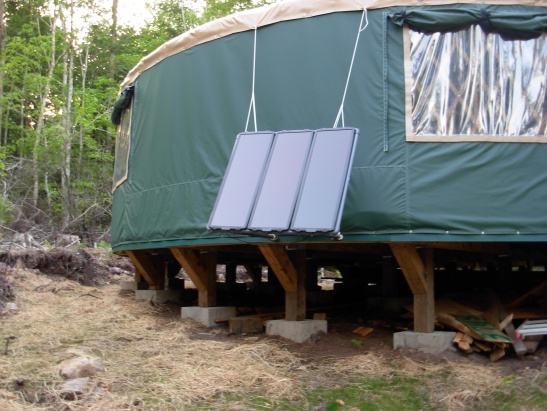
I got the solar panels for my yurt from harbor freight yesterday and assembled them here at home.. It was cloudy and well into the late afternoon but I turned it on anyway.. It was delivering 15 watts even in those conditions. Not bad!  I have to say, I expected the panels to be smaller and lighter but was pleasantly surprised to see they were well made and hefty. The PVC frame they give you is actually pretty decent, but the legs that attach to it are flimsy and I think would only work if you live somewhere that has absolutely no chance of snow.
I was fortunate because my uncle found a coupon for the set that saved me $40!
I ended up buying an Exide Nautilus NG-31 battery that has a 115 amp hour (20 hour) rating. I decided in the end to start with one and see how much power one battery will give me and also see how much I like this one before I go buying more.
After reading hundreds of reviews on the solar panels, I have come to the conclusion that the included power controller is not the best. After reading the directions I see they recommend you manually turn it off once the batteries are completely charged. I'm sorry, but this is the 21st century, this needs to be automated, especially since I am only at the yurt on weekends and vacations. So I went on reading a bunch of other reviews to find a decent yet affordable charge controller.. I settled on the HQRP solar charger. That should arrive today at some point.
I hope to get this installed Saturday at the yurt and finally have power for lights, the radio, and battery chargers!
I have to say, I expected the panels to be smaller and lighter but was pleasantly surprised to see they were well made and hefty. The PVC frame they give you is actually pretty decent, but the legs that attach to it are flimsy and I think would only work if you live somewhere that has absolutely no chance of snow. I was fortunate because my uncle found a coupon for the set that saved me $40!
I ended up buying an Exide Nautilus NG-31 battery that has a 115 amp hour (20 hour) rating. I decided in the end to start with one and see how much power one battery will give me and also see how much I like this one before I go buying more.
After reading hundreds of reviews on the solar panels, I have come to the conclusion that the included power controller is not the best. After reading the directions I see they recommend you manually turn it off once the batteries are completely charged. I'm sorry, but this is the 21st century, this needs to be automated, especially since I am only at the yurt on weekends and vacations. So I went on reading a bunch of other reviews to find a decent yet affordable charge controller.. I settled on the HQRP solar charger. That should arrive today at some point.
I hope to get this installed Saturday at the yurt and finally have power for lights, the radio, and battery chargers!
You can get cheap 12 volt lights (any car lights would work) and they wouldn't require the inverter. Same with the radio. In fact... I might have an old car stereo here, you could hook up. Then you wouldn't need the inverter except to charge your phones and stuff and could shut it off when not in use. I also think I have a Coleman lantern here you could use up there. It uses the Coleman fuel It would be GREAT for outside... and it's BRAND NEW... NEVER USED!
You can get cheap 12 volt lights (any car lights would work) and they wouldn't require the inverter. Same with the radio. In fact... I might have an old car stereo here, you could hook up. Then you wouldn't need the inverter except to charge your phones and stuff and could shut it off when not in use. I also think I have a Coleman lantern here you could use up there. It uses the Coleman fuel It would be GREAT for outside... and it's BRAND NEW... NEVER USED!
I have a radio up there that hooks into the DC adapters in the controller (not the inverter) and I have two DC lights already. I would love the Coleman though if you have no use for it.
Here is a video of the setup:
View attachment solar-setup.mp4
I did change the inverter hookup directly to the battery instead of through the charge controller.. After reading up a bit, I found that the 760 watt inverter would burn out that particular charge controller.
View attachment solar-setup.mp4
I did change the inverter hookup directly to the battery instead of through the charge controller.. After reading up a bit, I found that the 760 watt inverter would burn out that particular charge controller.
I have a radio up there that hooks into the DC adapters in the controller (not the inverter) and I have two DC lights already. I would love the Coleman though if you have no use for it.
Inverters use power to make power... and even when they're NOT making power! (It's minimal... but it's still power!) I bought the lantern for an old friend of mine who died before I got it to him, so any use it gets will be in his honor!
I understand about the inverter.. I only have the inverter there for things that are not DC, like the battery chargers for my porter cable tools and stuff like that.. For the most part, I just want to be able to power the lights, my little radio, and the ham radio I will have up there.. Almost all of that is DC.
Cool on the lantern.. We can always use light up there lol..
Cool on the lantern.. We can always use light up there lol..
Got it all hooked up, and it worked great. I barely used a 5th of the power I could have. The battery was completely charged by 9am. I think I will stick with one battery for a while. Here are a couple videos!
View attachment solar1.mp4
View attachment solar2.mp4
View attachment solar1.mp4
View attachment solar2.mp4
I stayed up at the yurt Saturday night and decided to try and give the solar system a run for its money. When I arrived the controller indicated the battery was full and that it had stopped charging; so it was full. I charged up all the power tools, the rechargeable radios, cell phone and whatever I could find to plug into it.
I had these two lamps I brought up a couple weeks before but just one of them set off the inverter fan so I brought up a couple other ones I had at the house that we didn't use. They were these little lamps we put behind some of our furniture with the intention of some mild back lighting. They each hold one 9 watt bulb, but we found the light too bright at home, but wow, they work perfect at camp. Even with both of them on, the inverter fan doesn't kick on, and they throw more light than the full size lamps do. They seemed to be drawing between 10-18 watts each off the inverter so probably an average of 1.5 amps each. That means I could run both of those lights for 18 hours before half my charge was gone in the battery (you shouldn't use more than half).
I have to say, I am really impressed with that little solar system. I am going to add one more battery for extra capacity, and a 2,000 watt inverter so I have the ability to run power tools and that will be it. Viva la-solar!
I had these two lamps I brought up a couple weeks before but just one of them set off the inverter fan so I brought up a couple other ones I had at the house that we didn't use. They were these little lamps we put behind some of our furniture with the intention of some mild back lighting. They each hold one 9 watt bulb, but we found the light too bright at home, but wow, they work perfect at camp. Even with both of them on, the inverter fan doesn't kick on, and they throw more light than the full size lamps do. They seemed to be drawing between 10-18 watts each off the inverter so probably an average of 1.5 amps each. That means I could run both of those lights for 18 hours before half my charge was gone in the battery (you shouldn't use more than half).
I have to say, I am really impressed with that little solar system. I am going to add one more battery for extra capacity, and a 2,000 watt inverter so I have the ability to run power tools and that will be it. Viva la-solar!
BTW, Amazon just recently went on sale with these 145 watt solar panels. Wow, $140.00!! If you are an Amazon Prime member, that includes free shipping!
I may eventually get a few of those if the need arises.
I may eventually get a few of those if the need arises.
I hooked up the second battery this weekend even though we never even had an issue with just one battery. I am pretty confident that is all the power we are going to need for some time. Ran the lights and the stereo all night along with the ham radio and the unit put out a constant 12.8 volts of power the entire time.

Surely Yurts - Steve
Manufacturer Representative
Harbor Freight 45 Watt Solar Kit
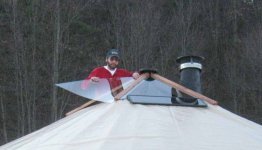
Yes, I have bought a total of about 20 of these kits I own 4 of the kits myself and use them at the workshop & yurt for all of my lighting and radio needs. The rest I have installed for customers and two of my neighbors in the off-grid community where currently I live. They are an amazing little system that is simple and effective. They have also held up, we got the first set 5 years ago!
Also, no need to worry about the charge controller over-charging the batteries. These are itty-bitty panels and controllers they don't have enough juice to over heat a deep-cycle battery and cause it any harm. Even at peak output they are only a trickle.
On a side note, the 12V deep cycle marine batteries are the way to go with a small solar array. We tried a set up with 6V golf cart batteries wired in series to achieve 12V. This was a disaster! They do indeed have more reserve capacity but once they go down these panels DO NOT have enough output to bring them back up. It is like trying to fill a swimming pool with a squirt gun. Word of experience with these small solar kits, stick with 12V deep-cycle marine batteries! If you need more capacity, just wire additional 12V batteries in parralel.
Yes, I have bought a total of about 20 of these kits I own 4 of the kits myself and use them at the workshop & yurt for all of my lighting and radio needs. The rest I have installed for customers and two of my neighbors in the off-grid community where currently I live. They are an amazing little system that is simple and effective. They have also held up, we got the first set 5 years ago!
Also, no need to worry about the charge controller over-charging the batteries. These are itty-bitty panels and controllers they don't have enough juice to over heat a deep-cycle battery and cause it any harm. Even at peak output they are only a trickle.
On a side note, the 12V deep cycle marine batteries are the way to go with a small solar array. We tried a set up with 6V golf cart batteries wired in series to achieve 12V. This was a disaster! They do indeed have more reserve capacity but once they go down these panels DO NOT have enough output to bring them back up. It is like trying to fill a swimming pool with a squirt gun. Word of experience with these small solar kits, stick with 12V deep-cycle marine batteries! If you need more capacity, just wire additional 12V batteries in parralel.
Attachments
Last edited:
Solar is the way to go. I plan on buying six Kyocera 250 watt panels, a bank of 6 volt golf cart batteries and some other needed controllers. I managed to scrounge up enough wire to do the job, connectors too! Nothing installed yet, still buying pieces right now. Can't wait till I start building something!