Ad

Roll on or paint on roof sealant for many small holes?

Hi Meg,

I'm not sure how much help I can offer given that my only experience is with Gaco on vinyl which is what my yurt cover is made from. If you could describe the "Test kit" and how it didn't adhere well to your fabric, I might be able to help more. However, what I'm reading thus far makes me quite nervous. I personally would not want to go to the effort with something that doesn't adhere well to your particular fabric. Going to the effort now to test various paints to find one that sticks well will save you a huge amount of time, headaches, and money in the future....and perhaps the not so distant future. I'm sorry to say that as I'm sure it's not what you wanted to hear, but....

That said, perhaps the Gaco sticks "well enough" that you can make it work. I'll just need to have you tell me more.

Re painting when the cover is off or on: That is something I debated greatly. I am really, and I mean really glad I did it while off....for a number of reasons. One being that I think it's much easier to get good coverage while the cover is laying flat. Two, the silicone paint will run and drip all over the place making one heck of a mess that would have taken me a lot more elbow grease (time) to clean up...with more nasty chemicals...and I probably wouldn't have been able to get it all. The Gaco is made for near horizontal surfaces, I believe.

I wouldn't worry it sticking to itself. Part of mine did....but it was the part that dried the least amount of time before rolling. Had I let it dry, I'm confident it wouldn't have stuck....but I was using a buddies shop and he needed his work space back.

Re cold temps, that's something else not to worry about with silicone. With other non-silicone elastomeric paints, it is an issue. Not with silicone. It'll dry when it's cold...it just takes longer. I touched up the spots in freezing temps after the cover was on.....where the cover had stuck to itself and peeled the silicone off. That was last fall. Those areas wintered and summered just the same as the rest of the cover did.

If the silicone isn't right for your cover, perhaps you could return the bucket you didn't open....and find a paint that adheres better. Of course, it would almost certainly be a paint that needed to be applied in warmer temps, in which case you'd need to find a heated shop big enough to paint it in...or wait till spring. If the shop wasn't big enough, you can fold part of the cover over on itself, paint the exposed part, let dry, unfold, then paint the other part.

Hope I didn't take too much wind out of your sail as I can certainly sympathize with what you're doing and up against.

Re the wool insulation, I don't know. Would have rather used that myself...but I also used a reflective bubble wrap....two 1/4" layers on the roof.

FN
 
Last edited:
Oh, and the only tip I have for painting is to make sure your cover is as clean as you can get it....and dry. With canvas, you might just scrub it with hot soapy water....or take it to a car wash. With my vinyl cover, I scrubbed with soapy water then cleaned with lacquer thinner.
 
For wool, it depends on what quality and how processed it is. If you were in E. Washington/N. Idaho, I'd have a contact or two to check with. Basically if you can find a local farm that raises sheep, you can probably get a good deal. Otherwise, find out who does the shearing in your area. When sheep get sheared, the wool on the legs, underbelly and rump (collectively skirting) is often a bit dirty and just discarded. White wool that is discolored or black wool that is sun bleached might be a little cheaper. Wool off the sheep has a lot of lanolin in it, which has to be scoured out--lots of really hot water. There are a very small number (less than 3) of industrial processing facilities for this in the US; one in Texas I think. The wool is shipped in 400 lb bales--it takes a small farm awhile to collect enough for baling & shipping to be economical. Purchasing low-grade/'utility' wool might work for you--but make sure the lanolin won't make things difficult for you. Or get wool that's been scoured but not necessarily picked or carded or spun or whatever. I assume you've checked with the few US places online that sell wool for insulation and they've come out too spendy? Best of luck!
 
Thanks for the quick response, you all.

As far the test kit that came with it, it has a small can of paint, a small brush, and 3 cotton strips. You take your surface, paint a strip, place the cotton strip down leaving one inch, un-stuck, then paint another layer on top. Let dry for 24 hours, then pull the tab( that you left unstuck) up. If the bottom layer of paint pulls also, with the top layer, you have bad adhesion. Only the top layer is supposed to come up. BUT the normal application for this is a flat solid roof, not just a piece of my yurt fabric. Is soaked in well, just didn't pass the pull test.

Of course they advise you buy the primer which is just as expensive as the paint itself.
The Company we are building our yurt with, knows people that have used this with success. I was just testing the waters to see who else i could find before i did it.

Glad cold temperatures won't really effect. We are trying so hard to get it up before winter, and that was a concern.

I have found yurts on yurt trader for sale, who have used gaco. So it seems to have worked at least enough.

I'll do more research. Thanks for the response.!

Meg
 
The Company we are building our yurt with, knows people that have used this with success. I was just testing the waters to see who else i could find before i did it.

I have found yurts on yurt trader for sale, who have used gaco. So it seems to have worked at least enough.


Meg

Hi Meg,

It's good to hear that others have used Gaco with success too. Was the fabric they applied the Gaco on the same as yours?

FN
 
If this is a vinyl cover you can chemically weld other pieces to it. get billboard material

Hi - Not sure who your response was to but my vinyl cover was welded together with heat. I actually replaced several sections with new vinyl by welding with a special heat gun and roller. It's a pretty easy method.
 
Just trooped through one high winds and two ARC storms with tons of pinholes in the skin of our expandable and my wife and I decided that we like the star effect the pinholes created in the expandable, but we don't like the water that comes with the effect. We are going to roll on clear flex seal in the interior we have another ARCstorm coming in three days so will let y'all know how it holds up.
 
https://www.google.com/?gws_rd=ssl#q=hh-66+vinyl+cement&*

One good way to patch the 18 0z. vinyl coated polyester yurt roofs is by using "HH-66" vinyl cement and paste scraps of "billboard vinyl" or any scraps of any 18 oz. vinyl coated polyester fabric. Ideally you would patch from the inside first .let it set. and then the outside. This is a pretty heavy duty chemical so make sure you are wearing gloves & have good ventilation etc...

If you are good with a vinyl heat welder you can use this to adhere the patch fabrics, this is by far the best way to do it but requires more technical skill and the tools. Should practice on test strips here. If you're not careful you can burn the fabric too much and get warping and fumes...

We have lots of 18 oz. vinyl scraps for free. Just email me at [email protected] and I'll mail you scraps for the cost of shipping have lots of different colors.

-Cheers!

P.S. - When a roof cover is past it's time (which starts with star-bust pinholes), we leave it in place on the yurt and simply put a layer of reflective foil insulation and a new 18 oz. vinyl coated polyester roof over the top of that.
 

Attachments

  • _SJR4722.JPG
    _SJR4722.JPG
    4.7 MB · Views: 778
  • _SJR4719.JPG
    _SJR4719.JPG
    4.8 MB · Views: 739
  • _SJR4725.JPG
    _SJR4725.JPG
    4.6 MB · Views: 816
  • _SJR4735.JPG
    _SJR4735.JPG
    4.5 MB · Views: 757
Hi everyone... Hoping someone can give me the benefit of their experience. We bought a used 24' yurt and now, unpacking it, find that the roof is full of pinholes... We're looking at the elastomeric options but all the manufacturers are telling me their product won't adhere to vinyl. I'm wondering if anyone has had luck with Gacoroof or another product? And if they can offer some guidance? Thanks!
 
Can't answer your question. Sorry. If you need in that yurt like right now, get a cheap plastic tarp up there, until you get a solution figured out.
 
Hi everyone... Hoping someone can give me the benefit of their experience. We bought a used 24' yurt and now, unpacking it, find that the roof is full of pinholes... We're looking at the elastomeric options but all the manufacturers are telling me their product won't adhere to vinyl. I'm wondering if anyone has had luck with Gacoroof or another product? And if they can offer some guidance? Thanks!


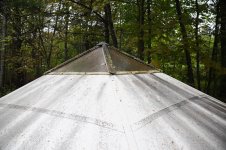
I'm sure you've come up with something by now. However, if by some chance you didn't......read post #17 in this thread. It is my experience using Gaco silicone paint...on vinyl.


For all others interested in this thread, after 9 years...here's an update: The silicone does not hold up well to abrasion. The ropes that help hold my roof panels on have rubbed the silicone off. We have also lost some silicone on the roof from slabs of snow sliding off. OTHERWISE...this stuff appears to be as intact and useful as it was when I applied it.


For reference, we're in the mountains which normally gets 7' of snow/yr (we got 10' this yr). The yurt is on a south facing slope getting full sun every day. It doesn't look new...but I don't care. It doesn't look shabby.


At some point, I will have to repaint the roof. As of right now though, I've seen nothing that makes me think I'll have to do this any time soon. Even if I do get a small leak, the water would just run down the bubble wrap insulation and end up outside anyway.


In summary, the Gaco silicone far exceeded my expectations and was many times less $ than a new cover. My cover is now 36 years old and I don't see why I couldn't squeeze 20 more out of it with another application at some point.
 
I'm sure you've come up with something by now. However, if by some chance you didn't......read post #17 in this thread. It is my experience using Gaco silicone paint...on vinyl.


For all others interested in this thread, after 9 years...here's an update: The silicone does not hold up well to abrasion. The ropes that help hold my roof panels on have rubbed the silicone off. We have also lost some silicone on the roof from slabs of snow sliding off. OTHERWISE...this stuff appears to be as intact and useful as it was when I applied it.


For reference, we're in the mountains which normally gets 7' of snow/yr (we got 10' this yr). The yurt is on a south facing slope getting full sun every day. It doesn't look new...but I don't care. It doesn't look shabby.


At some point, I will have to repaint the roof. As of right now though, I've seen nothing that makes me think I'll have to do this any time soon. Even if I do get a small leak, the water would just run down the bubble wrap insulation and end up outside anyway.


In summary, the Gaco silicone far exceeded my expectations and was many times less $ than a new cover. My cover is now 36 years old and I don't see why I couldn't squeeze 20 more out of it with another application at some point.

UPDATE


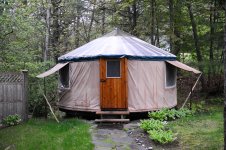
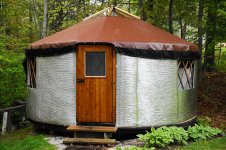
Last month, I noticed a drip inside our yurt during a medium rain. Then I noticed another, and another, and so forth. I looked behind the insulation and saw countless pin holes in the cover.


So, the silicone paint has reached its end of life for our roof. I suspect some leaks have gone undetected for a while...a year, two...I don't know. Regardless, I think this GACO paint is an excellent way to squeeze more life from a vinyl cover. It's ~$250 for the roof compared to a few thousand for a new cover which, might not last much longer.


I will be repainting again some time in 2024, hoping to get another 7-9 years from my roof.
 
Back
Top