Dan R-M
New member
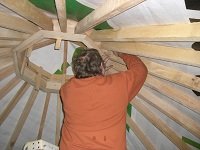
The rafters in my Spirit Mountain yurt are a tenuous construct, for sure. They are meant to be pinned into the center ring and notched (with locking screw) onto the cable. Were the Simpson A21's fastening the rafters to the ring "factory", or done by the first owner to add a little confidence?
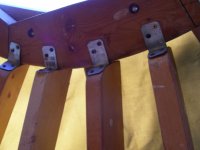
Who knows. But the first real windstorm we got this summer knocked down a few that hadn't gotten their A21's on yet. It was easy to put all but one back up. That one was one of two that are secured over the door.
Here's an opportunity to ask a question, rhetorically at this point, of what you do when the rafters have to attach over the door and can't sit on the cable. I didn't want to simply screw them down, 'cause I figured they'd need more flexibility. So I came up with something a little bit complicated but very functional. Or it would have been if I had secured the rafter at the ring, too.
Here's the dilly: I put two ~2x2" pieces on either side of where the rafter would sit, then drilled a hole through them with the rafter in place, and put an extra rafter pin through to hold it. The result is that the rafter can flex up and down, but if it happens to fall out of the center ring then the pin stays put in the door end and the rafter splits as leverage is put on the stubborn pin. And, like I said, I never would have known about that unfortunate feature if I'd secured the stupid thing at the ring in the first place.
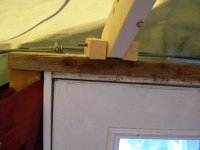
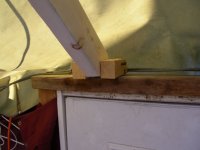
I left the yurt without this rafter for a while, then last weekend we got a whole lot of wind, and that brought down the other door rafter. So, in anticipation of a storm tomorrow I figured I'd better not have a two-rafter gap, and I fixed them both, complete with A21's.
Jafo, I recommend another Forum Topic: Fixing the Damn Thing.
Who knows. But the first real windstorm we got this summer knocked down a few that hadn't gotten their A21's on yet. It was easy to put all but one back up. That one was one of two that are secured over the door.
Here's an opportunity to ask a question, rhetorically at this point, of what you do when the rafters have to attach over the door and can't sit on the cable. I didn't want to simply screw them down, 'cause I figured they'd need more flexibility. So I came up with something a little bit complicated but very functional. Or it would have been if I had secured the rafter at the ring, too.
Here's the dilly: I put two ~2x2" pieces on either side of where the rafter would sit, then drilled a hole through them with the rafter in place, and put an extra rafter pin through to hold it. The result is that the rafter can flex up and down, but if it happens to fall out of the center ring then the pin stays put in the door end and the rafter splits as leverage is put on the stubborn pin. And, like I said, I never would have known about that unfortunate feature if I'd secured the stupid thing at the ring in the first place.
I left the yurt without this rafter for a while, then last weekend we got a whole lot of wind, and that brought down the other door rafter. So, in anticipation of a storm tomorrow I figured I'd better not have a two-rafter gap, and I fixed them both, complete with A21's.
Jafo, I recommend another Forum Topic: Fixing the Damn Thing.
Last edited: