Ad

Insulation

Hello,
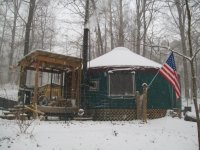
I'm new to the forum but I've lived for five years, full-time in a 24' Colorado Yurt. I heat with wood and the first couple of years were kinda cold, but for the past few years things have been fine. I have the shiny/bubble wrap insulation in the ceiling and I also installed the foam sheathing panels over the insulation and hold it in place with insulation stays. (If you're not familiar with insulation stays, they are pieces of stiff wire you cut and they fit between the rafters and hold the insulation without permanent attachment. For the walls, I used the thin moisture barrier that comes in sheets from Lowes. I then went to Academy Sport and bought 24 polyfill sleeping bags that I slid behind the wall lattice next to the thin blue insulation. I used those little clip things that are used to hold up curtains and zip tied them to the compression cable. They clip to the top of the sleeping bags and keep them from sagging. I can take the sleeping bags down and wash them and then put them back up. The sleeping bags cost 8 dollars each and I got all the green ones so the colors are the same!:D It looks good and it holds the heat. I also insulated the floor which made alot of difference. I'm open for questions as I feel my description isn't very clear.
 
Ok, you may just get the Yurt Forum most creative insulation award with that sleeping bag idea. That is most awesome. It has me thinking, have you ever thought of stuffing the sleeping bags with something? I dunno, shredded clothing maybe? That might bump up the R value a little.

Do you live by yourself in the yurt or?

If you ever get time, we would love to see some pics of your setup.

Thanks for sharing and welcome aboard! :)

- Jeff
 
Thanks! I haven't felt the need to stuff the sleeping bags. They are the kind that unzip which makes them approx. six feet square. I have them stacked two deep so there is about four inches of insulation. I live in Arkansas, so we have rather mild winters, but it still gets down into the twenties on many winter nights and the sleeping bags seem to work well. As for pictures, I have many but I don't think I know how post them. I live alone with my Boston Terrier Marty. I'm retired and have been for the past four years and I consider myself to be a young 60. I have tried solar, composting toilets, hauling water by hand, and many other successful and unsuccessful yurt living experiments. I can say after five years that living the my yurt has been the best thing I could have done for myself. Thanks for the welcome!
 

Attachments

  • 109.jpg
    109.jpg
    98.5 KB · Views: 1,355
cmwingfield..............Thanks for sharing your experience, I hope we hear more of your other successful and unsuccessful yurt living experiments.
 
Last edited:
Ok, here's an obvious problem solver, yet not so clear in the beginning. Insulate your floor when you build the deck rather than after the yurt is pitched. I did it the hard way and laying on your back under the yurt is much more difficult. By insulating the floor I was able to raise my winter temp. inside by at least 10 degrees all things being equal. I used fiberglass bats that I acquired from a commercial construction site. They were being thrown away as excess so I got it for nothing.
 
I think so many people forget about the floor when it comes to insulation because we just naturally think of heat rising. You're so right. Insulation the floor in ANY home will bring an improvement, but especially when the floor is on a deck above ground. I also think that if you blocked airflow under the deck in the winter, it would help mitigate heat loss from convection.
 
Here's another suggestion that has worked for me. In the heat of the summer, the sun bearing down through the dome can really heat up the inside of the yurt. Where I live, air conditioning is not an option as it gets really hot and it is miserably humid. I tried a number of ways to mitigate the sun through the dome. I have the screen that is suspended under the dome so I tried putting reflective materials on the screen to block out the sun, but I didn't like how it completely blocked the light source. I found the best solution by taking three medium hoola hoops, laying a line of silicone around the hoop then stretching one of those survival blanket things that are shiny yet translucent over the hoop. You can lay them like Olympic rings on top of the screen, they are light enough to offer limited stress to the screen and they are great to reflect the heat yet some diffused light comes through and you can still see through them to the outside. It works!
 
Thanks CM......can you expend a bit re how you insulated the floor, other materials, vapor barrier, critter protection on the underside, how you supported the batts, etc???
Is your dome clear or tinted?
If you're inclined to post more pics, we would love to see them.
 
I'll try and explain the floor insulation. As I mentioned, I got the insulation batts from a commercial construction site. They were going to be thrown away so I got enough to do the floor and to insulate a utility building that I use for storage. For the floor, I stapled the batts using the paper wings that come attached. I also used insulation stays, which are individually cut heavy wire that bend between the floor joists and hold the insulation in place. I was able to acquire some new landfill liner to act as a vapor barrier. If you are unaware of landfill liner, it is a heavy black plastic that is reinforced with unbreakable fibers that make it really strong. It is designed to hold the runoff from landfills so that it can be redirected into ponds so it is some tough stuff. It was another item that was being discarded so I got enough to do the underside of the floor. It is attached with Heavy staples and reinforced with stripping along the underside of the floor joists. So far no problem with pests, after five years. My dome is clear, which serves a good purpose in the winter, but in the summer it lets the sun stream in for approx. three hours. The hoola hoops with the space blankets let's me slip them in in the summer and then take them out in the winter. It's the best thing I've come up with to cut down on the direct suns heat.
 
Something I'd like to add is that I chose the 24 ft. yurt primarily because building materials are often sized in lengths that are easily divisible with the 24 ft. size. I hope this makes sense. It's much easier to find 8' or twelve' lengths of materials, whereas 10' or 20' are harder to find. I've found that if I keep my eyes open as well as my imagination, I can get lots of free stuff just for coming to pick it up. I look at it as a big experiment!
 
Hi My name is Ishmiel I have 3 Pacific yurts on my land... I live in Santa Barbara the climate is temperate so have not felt the need to do the Denim
I have however seen 2 yurts with the denim insulation placed between the standard pacific yurt insulation and the outer skin. you need to remove the outer skin of the yurt, tack up the denim insulation then put the outer skin back on. its a tight fit but worth the extra work and $'s The denim for the roof was also cut to shape to fit between the rafters. Small eyelets were screwed into the rafter every few feet then a thin piece of cord was weaved back and forth across the rafters to hold the insulation in place. That was all cover with beautiful indian tapestries. This system keeps the yurt much warmer. I would say 3 times the r value of the standard insulation. It also make the your much more solid under wind conditions...and helps with sound insulation.. In my opinion well worn the investment for your dweller in extreme environments.. Firm insulation under the floor seem to be the way to go.
 
Hi, I have denim inside my yurt walls, so it covers the pretty lattice, but is so warm it's worth it! 23 outside this morning and 57 inside - the fire went out before bed last night. I also have rigid foam in the ceiling, but I am having condensation problems - water is forming between the foam and the roof fabric and dripping into my yurt...anyone have helpful ideas for remedying this?
And I have rigid foam underneath my platform - huge difference in comfort levels! (Our old yurt did not have insulation underneath.)
 
You need to get some air moving between the ceiling and the backside of the rigid panels. If you "lower" them somehow so there isn't any direct contact, this will improve greatly. If there is no airspace here, you are basically trapping water between two plastic bags. Air really needs to be free (or enabled) to circulate everywhere inside a yurt to maintain a safe and healthy living space.

Are you augmenting with any type of gas heat? Moisture contained in the exhaust from any gas combustion unit will exacerbate moisture issues dramatically; to include cooking stoves, hot water heaters, etc.


Do you have some sort of roof or dome opening method? Keeping this at least cracked always, but especially when the outside temperature is below freezing will also help. Keep clean dry wood burning at night. even keeping a small 250F "maintenance" fire will solve most of it. But still, get some type of air buffer going on in that roof pronto.

Cost = $0
 
Is the denim insulation on the walls ever wet on the backside anywhere? Have you ever checked, especially after a good rain?

And what kind of yurt do you live in? Or more specifically what are your outermost roof and wall coverings made of?
 
Last edited:
We are in a Pacific Yurts, so it's a great, solid yurt.

There is a lot of moisture inside, we have a gas water heater and three people, cooking, laundry, etc. We try to keep the dome open during the day, but we have to close it at night - it's too cold.

Will sealing the insulation more tightly stop our water problems? It's definitely not leaks. It starts really coming down when the sun hits the roof in the morning.

Oh, and there is an air gap between the foam insulation and the roof fabric, but the gap stops when it hits the walls - those are tight against the lattice.
 
Open the dome at night at least 1/3 of the way and build a bigger fire when it's cold out. Pacific yurts are made of plastic, so your living space has no air exchange whatsoever when the doors and windows are closed. This is excellent at keeping heat in. Unfortunately, it is also excellent for keping moisture in too. No matter how much or how little moisture exists or is created in your yurt, you will be trapping 100% of it inside your living space when you are buttoned up. Simple.

I wrongly assumed you were already venting to some degree. This first, then mess with the insulation if still necessary.

You do heat with wood, yes?
 
Last edited:
Back
Top