Ad

How's Your Yurt Handling The Cold?

How is your yurt handling the cold?

  • Not good at all

    Votes: 0 0.0%

  • Total voters
    8
  • Poll closed .

Jafo

Administrator
Staff member
I thought we could start a poll here asking how you are faring with the cold this year in your yurt. It has been quite frigid here in the United States, and I would love to hear your anecdotes about how much fuel you are using, how/if you are handling condensation, any insulation issues, etc..

I will say that for my experience, I have only been up to my hunting camp a couple times during the real cold snap, and that was just to clear off the roof and check on things. I was able to heat the yurt up in about an hour from a cold start (13 degrees inside). During hunting season it would get down to 10 degrees and I was burning quite a bit of wood to keep the place warm.
 
We are doing well so far. We have had a couple of -25 degree days and a -30 degree day so far this season. We do burn a bit more wood on those days, but that is unavoidable. Our condensation problems have mostly been resolved. We picked up a dehumidifier to run in the bathroom which has helped tremendously with condensation, as well as a fan mounted up by the dome to get some air circulating up there.

We have a Shelter Designs yurt, with the standard reflective insulation, as well as their 'arctic insulation' package, which I believe has made a huge difference for us. I'm not sure how things would be going with just the reflective insulation.

We also took a 2" thick piece of rigid foam insulation and cut it the size of the screen insert that goes in our dome. We put that up on the really cold nights, which makes a pretty big difference (on the order of about 4-5 degrees).

Given all that, the temperature in the yurt has never dropped below 62 degrees, even on the coldest night. I'm a bit of a geek, and I setup a Raspberry Pi (A miniature computer) with a temperature sensor that takes a temperature reading every minute and posts it to a web database. This way I can monitor the temperature when we are away, as well as I get a nice history of the temperature inside. I'd like to get another sensor so I can monitor the outdoor temperature so I can see a nice comparison.

All in all, having a great winter so far!
 
We have had a cold two weeks with the temperature approaching the upper teens at night and not above freezing during the day, but after almost six years of year round yurt living I've worked alot of stuff out. A few extra logs at night and the inside temp stays over seventy. I have the reflective insulation on the roof and I have the floor insulated. My walls have a foam board vapor barrier and I have double fiber fill sleeping bags, unzipped and slipped between the wall and the lattice which gives me approx three inches of insulation in the walls. Heating only with wood I have minimal moisture. Right now I have the door open because the weather has heated up outside and it is hard to cool down a warm wood stove. :) I'm quite happy and wouldn't want to live any other way!
 
I added a 3 ton free mini split heat pump a few weeks back and it works well. Keeps it 70 plus if I want and we have had some teen weather in tennessee. My 30' is on a concrete pad and I put 5/8 inch foam flooring down which keeps the cold away. It has wood grain printed on it and looks great. No condensation problems for me. We don't live in the yurt, it is used for retreat group space. Love the site by the way
 
The stove I'm using is of a small fireplace 'insert' style, airtight design, approximately 1.5 cu ft firebox, and rated at 27K btu wide open. It will not begin to heat my uninsulated 16' yurt when the temps are well below freezing to zero. It is a good thing I'm not living in there with that paltry heat source.

When I fully stoke the stove, and leave the door and damper open for maximum heat output, I burn alot more wood than with the stove damped down.

Insulating the yurt would certainly make a big difference. From what I've read, Mongolians use felt as insulation, and probably are able to heat their 5 meter yurts with a stove similar in size to mine. Since I'm not gonna felt the yurt, a stove twice the size is in the works.
 
Regarding condensation, I have 17 oz double fill canvas cover, and 12 oz Home Depot painter tarp walls, so condensation isn't an issue. My yurt is real primitive. If I actually lived in the yurt full or even part time, it would definitely be insulated, and sealed up tighter.
 
Well... its going okay. This is our 3rd (and a half) winter in our yurts.

I think the only thing that really bothers me about living in a yurt year round is the exorbitant heat loss. We heat 100% with wood. We don't live in an overly cold climate like the mid grass praries. We have so far had a few days and nights of -15 C but usually bouncing between -10 to 5 degrees... its still early. Our temps usually don't plummet to the -25 range until end of january and february. We have the typical reflectex insulation which really does work... but at the end of the day a yurt is never going to be efficient insulation... but its okay... it has benefits that outweigh the drawbacks. We may need to start looking into further insulating the yurt since we plan to spend another few winters here while we build another house.

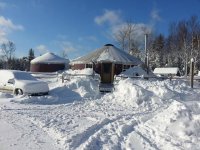
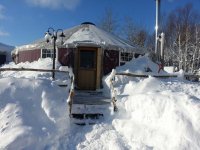
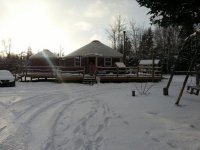
We have, however, been hammered with winter storms this year so far. Normally snow isn't on the ground until after December, but this year in less than one week we got more than 3 feet of snow... holy cow. Right now we have more than 3 months of harsh snowy winter ahead of us that we can expect another 3 feet throughout and we already have more than Februarys level of snow... I'm getting a little concerned about the rest of winter and where we are going to park this snow! This amount of snow is excellent insulation!!! We were nervous we wouldn't get enough snow this year to properly bank the yurt and help curb the heat loss. Wednesday this last week the snow is over most of the windows and only a foot or so from the roof line.

We don't have any inside condensation issues at all in our 30 foot yurt. We have a massive wood stove that more than pulls its weight, but the smaller yurt doesn't handle winter well without its own independent heat source. Its freezing or just slightly above freezing and then we end up with lots of frost and ice and dripping from the dome... so we moved the bedroom out of it and into the main house and everything is hunky dory now until spring! (lub spring).

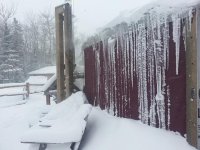
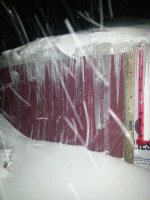
our biggest condensation issue is actually outside and it also illustrates the insane amount of heat loss that we experience living in a yurt... its disheartening, but its part of the experience of living like this. We get something I dub "Yurtsicles". They have been a big hit on facebook and people think they are funny (and they are) but to us they mean the heat escaping from the roof causes massive icicles to form all around the roof, but esp where the stove is located.They freeze around one of the ropes holding down the top cover (not a structural rope), but there are hundreds of pounds of ice hanging from them and they are impossible to break off as they are sometimes 4 inches of ice on every side.
 

Attachments

  • yurtsicles.jpg
    yurtsicles.jpg
    58.9 KB · Views: 1,382
  • bigger yurtsicles.jpg
    bigger yurtsicles.jpg
    50.5 KB · Views: 1,261
  • umm.jpg
    umm.jpg
    69.3 KB · Views: 1,495
  • umm... more snow.jpg
    umm... more snow.jpg
    64.8 KB · Views: 1,559
  • snow.jpg
    snow.jpg
    96.6 KB · Views: 1,434
I think I am fortunate that my yurt is up off the ground and not surrounded by a deck just for those fact that the snow never really comes up on the sides much. There is so much space between the platform and the ground.
 
Well... the deck definitely helps the snow bank up. In the kind of cold we have here and with the wind and persistent heat loss... the banked up snow to the roof is a welcomed change after a cold fall/winter. We aren't nearly blowing though so much wood to heat the place. We were actually kind of worried we weren't going to be getting much snow this year and would have trouble banking the yurt. Its insulation :-). A Yurtgloo!!! bahahaha
 
We also have yurtcicles, but they only form when the temperatures are hovering around freezing. The snow doesn't seem to melt off our roof much, a but around the dome when we have that cracked to vent moisture. The south side of the yurt had all it's icicles melt off, but the north side will have them until the thaw.
 
My location is Oxford, England. I have a 5 meter diameter Mongolian Yurt made of steamed willow held together with raw hide, covered with thick sheep felt and poly cotton canvas.

Last winter was one of the longest and coldest on record here. The yurt was covered in snow for a very long time. Regretfully, I was too scared to install my stove and left it too late so only had a 4 kw electric radiator. Despite that and some very, very cold days, I have no complaints.

This year, so far, the winter is very mild due to the the shift in the jet stream from the Atlantic. Sadly, that's much worse! Things would be a lot better if it were really cold. I have my stove working really well (wood burning oven) but due to the jet stream being right over us, it's really mild and it's dumping the Atlantic over us. Why is that bad? Well, when the jet stream isn't over us, it's cold but there's little rain. There can be lots of snow but when the snow isn't melting it doesn't start saturating the canvas so much.

I do also have a house but I find at certain times of the year, without any heating, the yurt is much warmer. There's a good reason for that, because the house is so solid that the building materials don't heat up, the yurt acts more like a green house and heats up with a little sun.

Fuel isn't an issue. I've seasoned some wood, I have a supply of non chemically treated scrap wood and a know someone who works in forestry. So for most of the time my fuel is free. Well, I say free, apart from the large investment of time and energy in gathering it, breaking or chopping it up and so on.

Last winter I have 'yurtsicles' from a long time. Very pretty.
 
Last edited:
I'm doing well. We had a cold snap with several days bellow 0F and the biggest challenge I faced was keeping my drinking water warm. I heat with kerosene so I have a huge problem with condensation. (I turn off the heater when I go to bed) Temps inside quickly fall to match those outside, but I have plenty of sleeping bags and quilts to keep me warm. I have no complaints, even on the coldest nights. I love yurt living and can't imagine moving back into a "normal" house. This is the happiest I've ever been! (With a dwelling) :)
 
I use the double sided reflective bubble wrap. I could only swing one layer this year. I plan on adding more insulation this summer.
 
Have you considered putting in a wood stove? Even a barrel wood stove would heat better I would think.
 
Had family over between Christmas and New Year and installed a 16' (authentic Mongolian) yurt in the backyard with one layer of felt insulation. I put two 1200W space heaters instead of the usual wood stove. I was very pleased to see that by -25C (-13F) ovenight, my guests completely stopped one of the heaters and lowered the 2nd to half the power!
 
I broke down and installed a wood stove in my 16 foot yurt. I gotta say, early on I had mixed feelings about it. Honestly, in some ways, my kerosene heater (23000 btu) does a better job than the wood burner--It's a decent stove too, and had no problem heating (over heating!) a 10x19 foot cabin. In the yurt, however, it takes hours to get the thing up to a decent temp.

I played around with them during the polar vortex when temps were below zero for several days. The kerosene heater warms the yurt to above freezing seemingly in minutes and to a comfortable 65F within 2 hours. The wood stove takes better than 2 hours to warm the yurt to 50F!

I hit upon a good combo though, if I know I'm going to stay home all day or going into town for only an hour or so, I'll light the kerosene heater first thing in the morning and fire up the wood stove. I'll then turn off the kerosene heater as soon as the wood stove gets up to operating temperature. At that point, I'll notice a drop of a few degrees, but the wood stove will hold inside temps to 65-70F and keep them there as long as I feed the stove now and then. On the coldest night, -15F, I kept the stove going all night. It was kinda nice waking up for once without ice in my beard.
 
Back
Top