Ad

Hoping to Build from Coppiced Greenwood

ChrisL

New member
Hello All, wonderful little forum here :) glad i found it.

i am finally working towards building a yurt, to be used as a home, moved seasonally, and was looking for some advice on using coppiced greenwood poles for both wall and room frame.

a quick outline / context of my approach to project:
I used to do a lot of traveling, hitchhiking, living out a backpack, sleeping rough. many beautiful experiences, but i got tired of 'drifting'.
last few years has been difficult, Anxiety / Depression. Led me to seek a more simple lifestyle.
moving to Devon, uk. a nice Eco-dwelling. no power tools, lots of hand-sawing wood and scything grass :) 21 acres of woodland, coppice rotation.
been volunteering for national trust (craftsman/woodsman volunteer). access to vast amounts of coppiced wood @ a good price.
looking to complete project without power tools, lots of time on my hands.
Iv a background in woodcraft/carpentry (mainly seasoned wood, not so much with greenwood).

so with the above in mind, im very keen to try and use coppiced greenwood, and to use just hand-tools.
(may consider sowing machine)

my main concerns are with the warping and bending of greenwood as it dries out.
is this a potential problem?
does wood need to be prepared in any way before construction/assembly?

most yurt building guides seem relevant to seasoned wood. struggling to find stuff on greenwood.

thanks for any advice.
chris
 
Green wood is weaker than dry. As such it will remain in its installed shape. Rafters will sag and lath will remain bent inwards. Big deal it is a yurt. I've built two and learned and shared here what I learned. I suggest, build the yurt, learn a few things, then you can tell us how it went. Good luck with your build.
 
Always good to learn something new.

I had not heard of coppice or coppice rotation before, even though you can't help but see it around, just not seeing it as a wood lot concept. Wikipedia is so helpful, hahaha.

Good luck on your research, attempt and build.

Rod
rod::email::yurtlocker.com
Home Page.
 
my understanding off coppice is of the long, thin shoots that grow up from the cut tree stumps.
if a tree is left to die, it will eventualy fall, begin to rot, supplying small eco-systems with a new home.
Or, during winter time, the big old tree draws most if its nutrients/sap into the roots.
If the tree is cut down during this time, come summer the stored nuritents/sap in the roots are drawn up into the stump, and use to birth several new trees from that one stump.
i usualy see about 4-8 new shoots.

in comparison to the origional, single big tree that was there before, the new shoots tend to grow tall and thin, in an effort to race upwards to the tall canopy of an already mature woodland.

the new tall, thin shoots make excellent building matierials.

weather a tree is cut/coppiced, or left to fall and rot, seems kind of a win/win situation-ish.

but yea, bob, thanks for reminder on trial - error - learning. there will probably be mistakes and failure, the project seems flexible enough for it.
im sure i will learn as i go along
 
I'll try to keep this short, but it'll be tough.

I live in coppiced ash yurts and have a campsite with coppiced chestnut yurts, so experience of both. I've been living in these since 2009. So I could rave about the many advantages of coppiced structures.

Yes, they're beautiful because they follow the form of the saplings. Yes, they're carbon positive, because you're taking wood that will grow back and the CO2 that's been absorbed by your yurt frame will stay there for as long as the frame exists. Apparently, a frame should last as long as a mariage - assuming it's a successful one of 50 years.

When you say "cheap", you should really be thinking about "free". You cut the poles, you strip them, shape the ends, steam them, leave them to set on a former to get the shape you want (mine are all Kyrgyz, for the higher walls). Then drill and knot the trellis etc.

Paul King's book (The Complete Yurt Handbook: Amazon.co.uk: Paul King: 9781899233083: Books) is a good reference. Or you could get in touch with Matt Boysons in Brighton, who still runs coppiced yurt courses, I think. The hardest part is the roof wheel, with heart of oak, nasty glue etc. You've got a few yurt makers down Devon way who can help out.

An industrial sewing machine with the right needle is what you need, with Sunbrella fabric. But I'd recommend doing a time swap with someone who can use that machine. My covers were made by my ex, who is a seamstress. Taking the cover on yourself could be a bit much.

I've blogged a load of stuff at thedevolutionary.wordpress.com including fitting chimneys, making platforms etc.

Good luck and let me know how it goes when you get time.

Alex
 
Last edited by a moderator:
Alex just said about everything I would have thought of and more. The only thing to add is that Paul King's book talks some about using coppiced wood and that I've seen several youtube videos of yurt making with coppiced wood (likely some of those makers Alex mentioned by name...).

Best of luck!
 
Well this old dog learned something new today. I made my 7 and 8 year old grandsons walking sticks from what turns out to be 'coppiced shoots', last spring. After cutting the shoots free from the stumps I found I could easily pull the bark off the shoots. The debarked shoots were covered with moisture and were very bendy. So I continually straightened them as we walked around the lake, and washed the slime just under the bark off my hands in the lake as well.


The last i saw them a few weeks ago they were dry and very straight. Not unlike making arrows. Now they're fully dried out stiff and are actually good walking sticks. So cppiced wood will easily take a set and dry out fast FWIW.

So, with that I'd say go ahead and just build the yurt.
 
So, with that I'd say go ahead and just build the yurt.

I most definitely am going ahead with this.

just so happen to have gotten Paul King's book a few months ago. a fair bit of useful info on using coppice greenwood.

Alex, thankyou very much for your post, it made me very happy.

really nice to hear about coppice poles being kinda "Free".

with the deterioration of my mental health over the last 3 years, i have kinda sunk into a financial hole.
my only feasible option for finance-based work is making and selling woodcraft's, but iv been having a lot of difficulties with creative drive lately.

the plan for yurt has, for a long time been, 'save up some money first' sort of thing.
but my financial situation seems to get bleaker every month.

probably got about £200-300 for project. so the notion of being able to source frame wood for a low/no cost makes me very hopeful.
(watched some ecovallee youtube vids, lovely, thanks for sharing)

*I have searched, for so many years to find a place to call home, the thought of making this a reality sometimes feels quite overwhelming :) *

i have contacted some people for sourcing greenwood poles, i need to give them some specs.
i found a site (simplydifferently.org) which has some nice 'calculators' for finding out design specs/dimensions/poles sizes, based on desired diameter and wall height.

for a 6M (1.5m-wall height) yurt, it came up with:
-138 poles total (there was another figure of 60, not sure what for though)
-wall pole length: 212cm
-roof pole length: 264cm (+7cm into center crown)
-1 inch thickness (not sure if that before or after stripping bark)

do these kind of figures sounds right to you guys?
 
I'd leave the rafter poles long and cut them to length later after you have your ring fabricated and propped up in place. To keep your costs down you are gonna have to do ALOT of work yourself. As far as pricing that's all in your haggling chops and being faire to both parties.


One thing is for certain. Yurts ABSOLUTELY have been built with less than perfect materials. The structural design is redundant. Try to get your laths holes as uniform as possible.

Obviously you are very smart so that isn't an issue. I assure you you can do this-and affordably- if you apply yourself. You aren't building a rocket or a piano. It's a yurt and yurts are very adaptable to building materials and procedure. Good luck.
 
You'd be better off cutting the poles yourself so you can strip the bark off straight away with a scraper. You'll also need a drawknife and shaving horse.

When I did this (in 2006, so memory could play tricks), we'd cut a dozen or so poles each and carry them back to the outside workshop. Then strip them, then shape the roofwheel end into a square and take wood off both sides of the other end for about 2.5 feet so it will bend without splitting. Then they were put in a homemade steamer and left for a few hours, removed and left to set on a former for a few days, before sanding and oiling.

The trellis in front of me is 1 inch stripped. The roof poles are 1.5. If you can find someone near you making yurts, I'd go along and meet them. Maybe help out. Maybe you can use some of their gear. If not, there's a good chance they'll be really good people. Working on your own, the frame could take you a couple of months. Then there's the roofwheel making to sort and the cover. Your budget won't stretch to much so maybe you should look at used fabric from marquee people. Or a yurt camp that's giving it up.

You might even find a whole yurt and cover for the money you have, which would save you all this. But you wouldn't meet so many people. Don't forget your flooring joists, floorboards, stove, pipe etc etc. Again you could barter your time for this. If you have a Transition Network project near you, get in touch with them, too. They'll have a network of people who will be happy to help out.

Once you're in your yurt, you won't stop dreaming. One day, I'll have a strawbale house. Mainly for the insulation. I'm burning far too much wood for heating in the winter.

Good luck from me.
 
Your numbers sound about right. 60 is probably the number of roof poles/uni, and you'll need slightly more than double that for the lattice/khana (ie, 138). I think 1"/2.5cm thick is probably normal for coppice wood. My yurt is from sawn lumber, but for reference the lattice is 1x2" (1.2x2.5cm actual) and my roof poles are 2x2 (4x4cm) shaped to an octagon ~1.5" dia. Your lathe length & lattice height are correct. Your roof pole/uni length sounds about right but you also need to know the crown ring/toono diameter.

I built lattice walls once--I tied it all together using paracord. Worked alright. The yurt I purchased used sex bolts/post & screws, which seem to work really well. Don't know what the cost differential is though.
 
many thanks for all the advice & encouragement.

gonna try document / photograph the whole process.

im not too worried about building the crown. iv a bit of a background with the finite furniter sort of things.
some years ago i had a go at building a chair with bent plywood legs. made a shape/mold by screwing shaped blocks to plyboard.
Then thin ply sheets, glue, G-clamps etc.

im looking forward to that bit.

thanks to all here. will keep you guys updated. im sure more questions to come :)

chrisL
 
If it helps bring the cost down, since I don't know what is cheap and available locally for you, I will offer up that I have seen yurts where the wall sections were tied together with rawhide.

If it is cheap for you to find a hide, or even scraps of a hide that had been cleaned, the hair scraped off, and cut into strips it would work. Horse might be best, but cattle hides work fine. I used to see them often at a local dog-food factory, but not every place has this option I think.

They had to soak the hide strips in water first to make them flexible, then they threaded the hide strips through the holes and tied a knot on the far side (larger than the hole), and then pull it tight and tied another knot on the close side.

Rawhide shrinks and hardens as it dries, so it will get tight and hard. If you can set up each khana as you complete it, while it is still a little wet it should help it retain the shape. If it dries first it will get pretty stiff.

Just a thought for you to consider IF this is a cost effective method.

Bolts, washers and self locking nuts seem great to me, but they are not particularly cheap.

Best of luck,

Rod
rod::email::yurtlocker.com
Home Page.
 
I ended up removing all the washers in my khana. I found if they were loose enough to allow the lattice to be opened and closed, they rattled in the wind. JME.
 
Hi all

run into slight issue, could use advice.

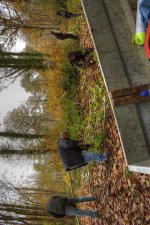
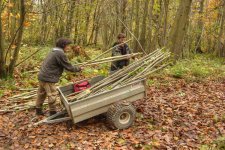
so i am sourcing the poles from some national trust woodland where i volunteer. they were really kind to dedicate a whole volunteer day to coppicing for this project. very heartwarming.

we collected 68 in this first batch for me to work with.

though, my heath has worsened, and personal finances looking dismal so i gonna have to try make some woodwork products to sell.

i got all these poles back and forgot about the stripping bark bit, havn't got a draw-knife.

so with all the above shenanigans, it looks like these poles are gonna be sitting around a while, im worried about them drying out and cracking.

should i paint the ends?

what can i do with a pole once i stripped of bark?
(it will start drying about before i got enough stripped poles to batch steam-bend + coat with linseed oil)
 

Attachments

  • IMG_9950.jpg
    IMG_9950.jpg
    10.1 MB · Views: 681
  • IMG_9952.jpg
    IMG_9952.jpg
    5.3 MB · Views: 716
Very nice pile of poles you have there. As far as drying out leave the bark on and if you are not cutting the poles off a half foot or so on each end, go ahead and coat the cut ends with glue or paint. Even with that expect some checks. If you aren't proceeding in the near future, expect the poles to have dried and bent every imaginable way. You could bundle them together. Good luck.
 
Back
Top