Ad

Choosing Floor Insulation

Hehe. You don't need a chainsaw to cut strawbales. They'll usually have 2, (sometimes 3 but on heavier/bigger bales or for hay) loops of either baling wire or baling twine. If you cut the wire/twine (knife or wire cutters), the bale will decompress and you can grab small or big flakes out of it.

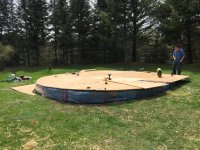
The thickness of plywood depends on how springy you want things and how much you want to spend. A 20 ft/6 meter yurt will require 11.5 sheets (4x8 ft). Yves used 1/2" thick and recommended thicker; if your straw bale platform is tight together and level you might be fine. I used 3/4" OSB and it was alright, but there was a few weird spots in the strawbales.
 
Also on the plastic wrapping--I looked at my notes and I used standard 8 mil plastic sheeting, which got lots of holes from screws poking it or even just the straw poking it. Either a different, stronger plastic or a much thicker plastic would be required for wrapping up your bales to protect from ground moisture/critters.

I kinda like Bob's double layer suggestion. You could get 1/2" plywood and double it up--should be a good deal sturdier and you wouldn't have to mess around with screwing into 1x2 underneath your seams. But that'd add $200 in cost vs maybe $20 for 2x4 or 1x2...
 
I didn't back read the thread.

From a builders perspective, ~$300 (including screws) is money very well spent if you can double thickness your floor, PLUS the advantage of stopping air, bugs, what have you from infiltrating your home from below. They are assuredly going to get in, as they do all homes, but at least it won't be through your homes floor. Plus, you can ALSO dismantle the floor down the road if you move. Having a nice and solid, dry, secure floor under your feet is totally worth the extra expense. And remember, your entire yurt home investment rests on top of that floor. A few hundred bucks for a designer colored bathtub is a frivolous expenditure. In this case it is money VERY well spent. Trust me. Good luck.
 
Hierony and Bob.

Thank you for your feedback. Awesome advises as always. No chain saw. Got it.
Double layer plywood is tough though. Not even the money wise but rather portability and logistics. I rent this place and if I have to move, that extra plywood could be a big hustle to move.

I think of going with 3/4 T&G and 1x4s for joint attachment.

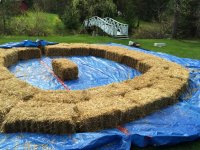
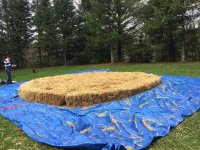
In terms of plastic, I decided to lay a tarp on the ground, lay bales, lift the sides and wrap a wrapping film in 5-6 layers around (Econo-Wrapper® - 80 gauge, 20" x 1,000' S-1831 - Uline)

I will probably need a generator to power a jig saw to cut the plywood to size.

On a side note. What about the foam? What if I use it on top of the bales before putting the plywood on top?

Kochevnik.
 
I was thinking if you used a doubled layer of plywood, you could also put some foam insulation between the two. It'd require longer screws, but it would effectively be SIP panels, right? I've seen some composite systems with foam sandwiched between, so you're likely to get some structural benefits from it (especially if you put down glue :p)

A battery operated saw (skil or jig) can get you through the plywood cutting job. Two batteries might be required, but I'd guess ~$200-300 for everything new whereas a generator would be a bit more (unless borrowed or a low-end model purchased). But if you'll need a generator for electricity later it might be worth it. You'll also need a drill for screws.

If you're familiar and comfortable with electricity, there are ways to connect some battery-powered tools to vehicle batteries. But I don't want to encourage something that can be destructive (to people & equipment) if improperly done.
 
Thanks for the feedback.

I am still quite firm on one layer of plywood. I was thinking of using a foam on top of the bales. To stiffen them and get a better level.

What do you think?
 
I have no experience with a floor install like that. Sorry, I can't offer an informed opinion. Maybe just go for it? You'll learn soon enough if it will work. Being easy to assemble, and disassemble, you really won't be out alot of money, and the materials will be easy to reuse in another configuration, or, on another project. Trying something is the best teacher anyway. Good luck.
 
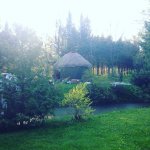
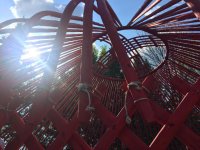
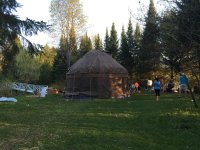
I finally raised my yurt on a straw bale platform. Not an easy task. I also screwed up some dimentions so I will have to think about a lip to avoid leakage.

Thank you all for your support.
 

Attachments

  • 13240658_10154104541160256_8137057196415945011_n.jpg
    13240658_10154104541160256_8137057196415945011_n.jpg
    111.7 KB · Views: 817
  • 13241102_972304882884062_5396313955295509078_n.jpg
    13241102_972304882884062_5396313955295509078_n.jpg
    98.9 KB · Views: 880
  • 13254124_972304389550778_8831610305656344402_n.jpg
    13254124_972304389550778_8831610305656344402_n.jpg
    156.8 KB · Views: 954
  • 13254243_972304486217435_4511378243529159037_n.jpg
    13254243_972304486217435_4511378243529159037_n.jpg
    141.1 KB · Views: 1,153
  • 13260133_972304446217439_2704302695661741135_n.jpg
    13260133_972304446217439_2704302695661741135_n.jpg
    149.4 KB · Views: 1,062
  • 13226976_972304909550726_6042724275311065385_n.jpg
    13226976_972304909550726_6042724275311065385_n.jpg
    124.2 KB · Views: 905
Ahh I see. Well, then you are fortunate to have learned something. Next time, you will do it differently. That's half the fun! :)
 
Here's an easy way. Get the tarp laid out, and pick a focal point of the yurt. Drive a stake through the tarp that has a nail in the top. Or have a friend hold the dumb end of a tape at the focal point. Draw the footprint of the yurt on the tarp with a magic marker. Fill in the circle with bales and wrap them.

Build your platform letting the plywood run wild. Find the focal point again and drive a nail. This go round accurately draw your yurts perimeter on the plywood with tape and pencil or marker. Cut to shape. In essence that's basically how I cut the 2x6 boards of my yurt platform. Voila! Perfect circle.
 
Back
Top