Ad

Choosing Floor Insulation

conantum121

New member
I am installing a 24ft. Pacific Yurt, Winter Insulation package for walls and roof, 4*6 beams sitting on 4*4 posts, 1&1/8 ply floor. Im in Northern California: hot summer, cold and wet winter. Im looking for advice on the best insulation for the floor. I've heard a lot about the rigid foam. Im interested in non-toxcicity and insulation value. Is there an effective eco-friendly option that won't get moldy and attract critters? Vapor barrier recommended? Thank you.
 
Last edited:
I'm a fan of straw bale platforms--nice and thick insulation. It won't mold IF kept dry (ie, don't let water pool on it, make sure water drains away from your platform; potenially seal with stucco). I don't think you could easily use this for your framed platform though.

Sheep wool might be an option. Somewhat spendy but there are a couple places that market it as such. Often treated (w/ simple boron salts) to deter wool moths. Naturally flame-retardant. Available loose or in batt form. Some small local sheep farms might have a bit stashed away available (may not be washed or processed or treated)--contact your local sheep shearer for names.

I've also seen websites selling hemp insulation, cork insulation, shredded newspaper/cellulose insulation, cotton/denim insulation. I know cellulose is often used, denim sometimes used in normal construction.

There's one or two manufacturers that claim their glass wool or mineral wool is eco, for what that's worth. I count eco as something that *will* mold/attract critters, in the right circumstances. The trick is to prevent those circumstances (moisture accumulation, mouse access/population). Moisture barriers, keeping things off the ground away from water/mice, getting a good mouser cat, wormwood to deter moths, are all ways to prevent said circumstances :p

You might also consider a different platform style--a slab foundation under a raised platform would allow you to entirely enclose the slab (effectively preventing critter infiltration), place whatever type & quantity of insulation you want down there, plus give you storage space.
 
Last edited:
I'm a fan of straw bale platforms--nice and thick insulation. It won't mold IF kept dry (ie, don't let water pool on it, make sure water drains away from your platform; potenially seal with stucco).

I'm interested in your strawbale thoughts. I'm guessing from your picture that you are using this for your floor? Did you lay your bales right on the ground or build it up somehow? Did you use any vapour and/or moisture barrier(s)? Do you have any issues with surface water when it rains or snows? Any other tips or realizations would be appreciated as we are awaiting our GroovyYurt this spring and are debating the various floor options.
 
Hello Zelig,

It was actually from Yves of Groovy Yurts that I learned about the strawbale platforms--he's posted on the forums about his setup. I emailed him for more details--I'll share what I learned/he said (he's more verbose in french). I also have a few photos of my setup in my album. I started with a rectangularish platform which didn't work well, then rebuilt it circular to fit under the yurt (much better).

Yes, I am using the strawbales--I like them because it will be completely movable and I won't leave gravel or cement piers or holes behind, just a bare spot (the original meaning of 'yurt'). It also keeps the yurt above groundlevel, so no worries about water or snow getting inside. Of course, don't setup in a low spot with poor drainage where water will collect into the bales. Yves said he didn't have problems with moisture in the bales at all, that they looked new when taken up after two years.

Levelness: I was lucky to have an old asphalt pad already level for me--except for a tree root or two pushing up the asphalt in one corner. The bales did not smooth out the root bumps--I would recommend making your 'base' as level & smooth as possible/reasonable (<1" deviations). Yves suggested putting down a layer of gravel and then an 'earth sheet'/plastic layer to really do things right, but he didn't have the time during his setup. I didn't use anything under my bales (except asphalt pad).

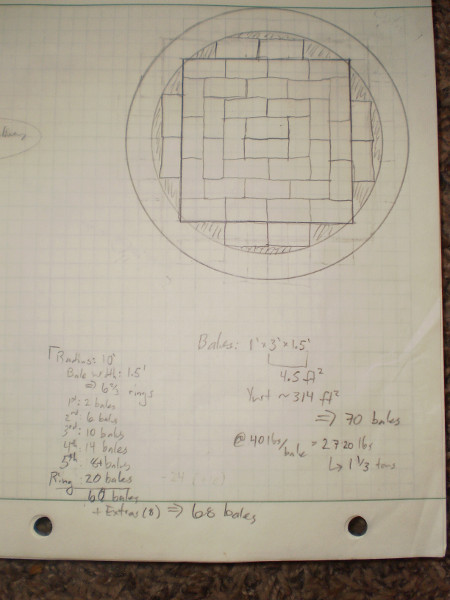
Arrangement of bales is important--the yurt on top protects the bales underneath from weather. Anything sticking out will get water/snow on it and potentially mold. I made this mistake initially--I arranged my bales as a square inside the yurt circumference with the outermost bales sticking out (plus my OSB sheets stuck out initially, too). Then it rained, they got wet and the bales molded some :( Below is what I'd make from scratch--I think my setup actually has two or three circular layers instead of just one though.

Start by putting two bales in the middle with a rod/stick to define your center; use a rope/board to scratch the outer circumference. Tie a rope/cord the circumference length--paracord would be sufficient & cheap; ratchet straps are overkill. Knee/kick the outer ring of bales to fit the curvature & use the cord to hold your circumference. Then stack outwards from the center until you can't get anymore whole bales inside your outer ring--fill the gaps by stuffing with portions of bales. Make sure everything is level--adjust with bale flakes as need be.
1534-albums86-picture947.jpg


Plastic sheeting--I originally had 8 mil plastic between the bales & OSB. I was planning on tucking it up inside the canvas under the lower rope once I cut the OSB circular, but it caught water before I got it setup that way. A couple spots on the OSB started to mold, plus a fair number of bales underneath got water through holes poked by straw/screws and started to mold, too :eek: Once I noticed this, I rebuilt circular and omitted the plastic sheeting.

Platform--Yves used 1/2" plywood sheets, I used 3/4" T&G OSB (11.5 sheets for my 20' ger). A little thicker would probably be good to reduce flex. Plywood is probably better than OSB (better water resistance/less edge swelling, less outgassing). I tried using screws though the T&G joint to hold everything together but it didn't work. Similar to Yves's setup, I ended up using 1x3 (furring strip) underneath all the joints to screw into to hold everything together. This picture shows one way to do this--perpindicular pieces would be required if not using T&G. Cutting the platform close to circular is essential (it'll catch water and cause problems otherwise).

Drip edge/border lip/skirt--with a traditional yurt like Groovy's, you'll want to have a drip edge/border lip/platform skirt. It'll keep the lattice on the platform in *very* strong winds; with the canvas & vapor barrier outside it/insulation & liner & lattice inside it'll help seal up the yurt; and also gives an exact diameter for setup purposes. I initially ignored this, but am going to install one shortly. I'm not sure what Yves used--maybe thin plywood? I'm thinking of using 1/4" tempered hardboard cut ~6" tall in ~2' long sections, screwed into the 3/4" thickness of the OSB.

As for critters (mice/insects), Yves didn't have any problems but he also had a cat. When I was rebuilding everything circular after the water problems, I did notice earthworms under the moldy bales. I'll probably be moving my yurt here come June, so I can report back on what's underneath :P I also have a design for a modular T&G board (pine or cedar) platform in place of the OSB, but need to test it first. If you really wanted to seal everything up, you could stucco the outermost side of the straw bales and glue/seal all the plywood joints. With just the canvas (no liner, no insulation, not a great seal between the canvas/platform edge but the crown ring covered) the yurt'll warm up with my 15-25 kbtu/hr propane heater in ~40 minutes.

Oh, each bale was $2.75 each, ~1'x3'x1.5' direct from farmer. I think I got wheat straw but there may have been some barley straw, too.

Let me know if you have anymore questions.

 
Last edited:
My question about straw bales is, don't they eventually rot? How long do they last?
 
You know, some people have made entire houses out of strawbales :D Internet says/rumor has it there are strawbale houses over 100 years old. Mind you, these would be sealed with plaster/stucco--if you keep the moisture (and vermin) out, you keep the mold/rot out.
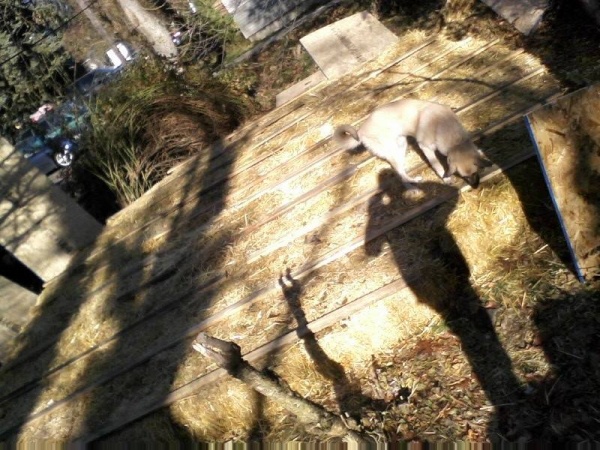
My yurt and the few other pictures that I've seen with strawbale platforms have covers that hang down below the platform at least a couple inches (up to a foot)--the yurt covers and helps protect the bales from rain. For plain bales, I'd guess anywhere from 2 to 5 years durability (unless they get wet during building). I think this is a great setup for temporary or short term yurt locations. Also almost dirt cheap (20' yurt: $200 straw, ~$200 plywood + screws + furring).

If you want something more permanent, you'd have to seal the outermost face of the straw with stucco/plaster, maybe put down sand and a moisture barrier underneath the bales. In that case, it'd probably last the life of the platform/yurt if sealed correctly.
 
Thanks Hierony for your responses. Unfortunately for me, a bale costs about $6 CDN, but that is still within reason for the R-value, simplicity and non-toxicity value. Also, if the straw spoils it is still of value to us as mulch for gardens. My biggest concern is the water. We have a pretty level piece of land with heavy clay and in the spring and fall it gets quite wet, so I'd have to pick an elevated area and probably build it up a bit more with gravel.
 
Well, toxicity aside, what about wrapping the bales in that plastic they wrap round bales in?
 
As long as you don't have any moisture sources inside/under/on top of your bales, you probably could just seal with any available plastic (UV stable). Tyvek would allow things to breath, but water vapor could get into the bales that way, too. [Tyvek is basically just a specially-made polyethylene tarp; it blocks convection/mass air flow & liquid water but not water vapor going either direction--not rec'd for humid environments].

Zelig, it sounds like you have a pretty tricky landscape. If you're Northern Ontario with a wet clay soil, do you get ground heaving during the winter? What's your biggest elevation difference? How deep is the frost line? Are you trying to go light, cheap, and simple? Or as insulated as possible for reasonable cost? DIY or professional construction?

SeverTheTether's setup for Northern Minnesota looks pretty nice, albeit spendy. They insulated the walls in the space between their slab & platform with spray foam I believe, and it sounds like they're pretty warm for it. You could probably replace the crawlspace siding/spray foam with straw bales if you sealed them with plastic/tyvek.

A two course (~11"/28 cm) circular retaining wall back-filled with gravel might do the trick raising you some. Est. cost for 6m/20' yurt is $300-600 for materials.

Somebody had the idea to combine earthbag foundations, scoria/lava rock, and yurts already. If you have lots of clay already, you might consider a cob foundation or such, too. Lots of options if you get creative!
 
Yes, we get frost heaving and our frost depth is probably about 8ft or more. The charts for frost depth I've seen seem pretty broad-brush in nature.

Our "topography" over short distances has a range of 2-3 feet and the entire 26 acres might have a slope of 8-10 feet over the 1500-ish feet going toward the SSE.

I've been thinking earthbags, particularly because of the ability to use local soil and for the impermanence. We don't have a clear picture yet of how we want to develop the land and really just want to get set up there so we can spend all of our time there, learning its features, quirks and challenges.

I was under the impression that our climate is not cob-friendly, at least not as an exterior wall/foundation.

Another challenge we have is that our window of opportunity for working outdoors is pretty brief- June through September is about all we get and we have lots of permaculture projects that we want to deal with before focussing on a more permanent dwelling.
 
Have you considered using earthbags to make a slightly elevated level area, then using strawbales? Btw, the feedstores here charge 5 USD for a bale while the farmers charge ~$3 (sometimes including delivery). If you haven't already, might be worth checking craigslist/newspaper ads (fall is best time, of course).

Sounds like you'll have your work cut out for you--from what I've seen, permaculture takes some finesse to get a good system, but can be incredibly rewarding once setup. You'll have to post some pictures in the Simplicity/Everything Else categories :P
 
I found that 4" blue SM, cut to fit between the floor joists and up tight against the plywood floor, made a huge difference in how warm my floor stays. My first winter in the yurt was a challenge to say the least. First snow fall was late October and stayed until April.No insulation in floor and no skirt to close in the bottom. After the first storm under the platform completely drifted in with snow, which in turn put a real good frost on the floor inside. No fun. Second winter I piled hay bales around the perimeter to keep the snow out from underneath but the mice seemed to think I built them an apartment complex. After a mouse genocide, I got rid of the hay and scored some left over 4" blue SM from a job-site. Once the floor was completely insulated I sealed the critters out with old barn master roof metal screwed to the bottom of the joists. Then closed in the skirt with T&G 2x6 and used glass block on the south side to allow some sunshine to do its magic. Now with -28 C sustained for 3 weeks, I can still go barefoot. Floor is toasty warm. Plus the added bonus of the skirt keeping the snow drifts at bay. I found yurt living requires a severe learning curve. When I inquired about how much insulation I would need the answer was always the same. MORE.. Now I just need to figure out my water freezing issue and hopefully next winter I'll be living in the lap of luxury. Good Luck and remember to have fun. life's to short to sweat the small stuff.
 
Jay--did you really use hay bales? Mice would love the hay (seeds, green tasty legumes/grasses and all) much more than just straw (dry grass stalks). A search or two around also suggests if the straw isn't stacked tight together, mice like to borrow into it a lot more.

From your experience, it does sound like any floor insulation makes a world of difference! I'm a little surprised more yurt places don't put more emphasis on better insulation (floor & walls).
 
Just bumping up the post.

I will be building a straw bale platform within the next couple of weeks and will keep you posted.

Thank you hierony for your help
 
Hello,

I am in the process of purchasing plywood for my platform. Can you tell me ideal thickness and also if pine is better or worse than fir?
One more question. How do you cut straw bales? Anything except chain saw?

Thank you
 
Last edited:
Mice are part of a long biological chain of critters that can live under your yurt. Rabbits and mice are currently living under mine. And who knows what else. Very low deck and I can't see under it. I'm glad I did considering what lives under there now. lol

I'd use 3/4 T&G 'exterior rated' plywood. I absolutely would NOT use osb if there will be contact with damp organics other than wood framing and air exposure. I suggest you paint the side that faces down, towards the bales or framing, with two fat coats of cheap 'ooops' paint from Depot Lowes or wherever. That protects it very nicely.

That's what I did to the underside of my 2x6 yurt platform decking. As an aside here I even painted the subfloor of my house to protect it during the build, since I framed it myself without a crew. It took a lot longer before it was dried in.

You can also caulk the gap for a bombproof seal. Use thin cheap caulk. If you really have no framing to anchor the plywood to, and it is essentially free floating atop the bales, I'd go two layers. Run the first layer, then the second perpendicular to the first and screw the two layers together. That will be solid as all git out, and keep ALL the critters out. 'Nothing' will come up through that floor.

Have fun building your place.
 
Back
Top