Ad

Building the Aroura

Andy_in_Germany

New member
Thanks to the help I'm getting here and books by the like of Paul King and Dan Frank Kuehn, I'm able to start making sketches of our Yurt. Because I'm a romantic old softie I've taken to calling it the Aroura, hence the odd title.

Anyway, the first very rough sketch should be attached to this post. I work on the basis that if I start sketching and working things out I'll gradually come to a final design I can build. I'm aiming for a 12 foot/3.65m diameter Yurt.

So the first questions for the Yurt frame:

1: How wide are the wall lattice poles? I was aiming for Ash or Beech square section poles (bear in mind I work at a carpenters workshop: making this from planks is fairly simple). I'm assuming a cross section of 19mm by 19mm (3/4 of an inch square) will be enough. Is this correct?

2: What size should I make the rafters? I'm assuming I'll need 39 rafters (as suggested by Paul King), and I'l make then with pine or spruce. King suggests 32mm x 32mm (1.25in square) but this seems small especially if they have to carry snow (even with Baghana roof supports) and suggestions?

3: In some yurt pictures I've seen vertical supports going from rafters to the ground where they meet the walls. Are these snow supports or for exra security?
 

Attachments
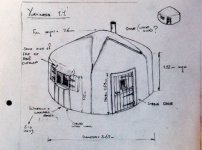
  • Yurtiness_1.1.jpg
    Yurtiness_1.1.jpg
    96.7 KB · Views: 915
Last edited:
Usually we have about two feet max, but in a hard winter we could have up to twice that if it falls faster than it melts.

Buildings locally have to be made to withstand about nine feet of snow on the roof, but I've never seen that much snow.
 
Usually we have about two feet max, but in a hard winter we could have up to twice that if it falls faster than it melts.

Buildings locally have to be made to withstand about nine feet of snow on the roof, but I've never seen that much snow.

I am not sure how building code enforcement works there, but I am betting it is pretty similar to here. If they are asking for it to hold that much snow, then definitely consider 2X6 rafters with studs. It wouldn't surprise me if they want some kind of engineered specs on things like snow load too.
 
Sounds more realistic. Many thanks.

Because the yurt is made partly of canvas it is considered to be a 'tent' or 'temporary structure' and thus not subject to as many planning laws, although I'm supposed to take it down at some point.

This is one reason I'm making a yurt: a 'permanent' building would never be permitted.

That said, there may be weeks when I can't get to the garden for all the snow, and if I've left the Yurt up it will be comforting to know it's solidly built (and nice to be able to use it in winter too), so 2x6 and studs will be the way to go.
 
Another thing you might consider is, if you build it well enough with these codes in mind, you might just find that they approve it. :)
 
Another thing you might consider is, if you build it well enough with these codes in mind, you might just find that they approve it. :)

Alas, not unless I spend Euro 10 000 fitting a sewage line I don't need, and even then it is unlikely: no-one here has heard of Yurts, so they won't like the idea, and the local authority is in a big fight with a number of people locally who it deems to be living in 'illegal' houses, and I discovered the nearest 'illegal' house is only about 300 feet away from my land, so I doubt they will be very keen.

This is not intended to be where we live forever. Having a Yurt will mean we can take it with us when we finally move on, which will give us some flexibility then.
 
I'm currenty signed off sick from work with gammy elbows: I'm not allowed to lift anything, which is a pain for a cabinet maker.

A pain for Yurt making too, come to that.

Research doesn't need biceps, so I've been working out how much wood I need, what kind of wood to go for, and what the german words for some of the materials are. I've just got an email from the person running the http://jurten.heimat.eu/ website telling me that the German for 'canvas' is "Tipi-Stoff" lit: "Tipi cloth". Thanks to Jafo for posting that link.

So far I've decided that the wall rods will be European Ash, the roof rods spruce or pine depending on price, and the crown ring red beech.

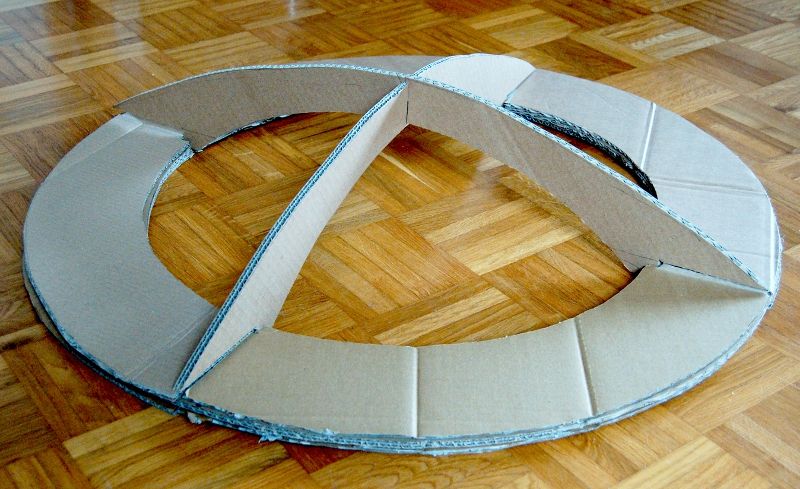
To help me work out the quantities, I made a cardboard mockup of the crown ring with my youngest son this afternoon. I'd put a picture or a link but the software won't let me...


a>
cardboardyurtring.jpg


cardboardyurtring.jpg

cardboardyurtring.jpg
 
Last edited:
Ha! This is the first time I've ever heard the word "gammy" used outside of the Monty Python Cannibalism in the Royal Navy sketch.
"I'm done for. I've got a gammy leg and I'm going fast. You'd better eat me"
"Eat you, sir?"
"Yes. Eat me."
"Ugh! With a gammy leg?"
Not to digress, or anything. But of course it has found its way into my brother and my vocabulary as a result.
I love your plans, Andy, and your commitment to using local materials. I look forward to seeing your progress.
 
Are you having an issue uploading pics?

Hi Jafo. T thought I was, but it seems it was working. When I went through the motions of upoading the image didn't display on my post, so I thought the techno-gremlins were not cooperating. It seems that things were working, and as soon as I can remember how I did it, I'll upload more images.
 
Ha! This is the first time I've ever heard the word "gammy" used outside of the Monty Python Cannibalism in the Royal Navy sketch.
"I'm done for. I've got a gammy leg and I'm going fast. You'd better eat me"
"Eat you, sir?"
"Yes. Eat me."
"Ugh! With a gammy leg?"
Not to digress, or anything. But of course it has found its way into my brother and my vocabulary as a result.
I love your plans, Andy, and your commitment to using local materials. I look forward to seeing your progress.

Hehe. I guess Monty Python is part of my cultural heritage, for better or worse...
 
I'm still putting together the materials list, but I'm 90% happy with the wood frame and parts, so it is time to move on to the fabric.

I'm a lot less sure of myself here.

I've found a german supplier online who sells material they describe as:

"Olive sailcloth. WATERPROOF 205cm wide awning material, tent sold by the metre, cotton..."

Their description reads (All translated text in italics):

"Highly robust 840 grams per square metre with canvas seams.

this material was developed for large tents (Lit: Großraumzelt or 'Big room tents': defines anything from a scout tent to an Oktoberfest beer tent or circus tent) and has the following qualities:

Waterproof & oil, dirt, and fat resistant. Tepmerature and light durable and mold resistant."

--------------------------------------------------------------

Which sounds all well and good, but I've had conflicting advice from the owner of the main German language yurt website I've found, who kindly emailed with a lot of advice, including:

"... "Tipi stoff" is extra strong cotton: weight minimum 450, better 650 gramms per square metre (G/m²) waterproof to a rainfall of 65cm per square metre (cm/m²) with rotproofing, but in my experience you can forget this because the rot proofing washes out and if the yurt is permanently outdoors it will be revolting and toxic and and mouldy within three years.

A mix is better: 50% cotton and 50% polyester, weight 470g/m², waterproof to 80 cm/m² rainfall.

The best is Polyester 280: 100% resistant polyester with acrylic coating. Natural colour, weight 280g/m² breathable and rot proof. Waterproof until 100 cm/m² rainfall. Also known as "Markeisenstoff" (
"Awning material") You can find it on Ebay, amongst others..."


Back on Ebay I've found:

"Heavy, rip-proof Oxford Nylon"

Rip-proof nylon mix with matt robust surface. The back side has a PU coating making the material permanently waterproof. Can be sewn with a standard domestic sewing machine.

400g/m²
80% Nylon, 20% Polyeurathene

Waterproof, rip-proof.

Designed for:

Geeignet für: convertible car roofs, canvas covers, shelters, pavillions, Unterstände, Pavillons, awnings, sun and rain protection, Sonnen-u. Regenschutzsegel, canopies, viewblocks, wind protection, bags, rucksacks, etc.


And:


klassischer Markisenstoff


250g/m²
100% Polyacryl

Waterproof, rop-proof, oil, dirt, and fat resistant. Weather and rotproof.

Usable for: Awnings, balcony covers, canvas covers, shelters, pavillions, sun and rain protection, wind protection, etc.


Scores seven-eight of a possible eight levels of fade resistance and water resistance of 7-8. included resistance to bird droppings. also has a 50x UV protection, so the colour won't fade in sunlight. waterproof to 35cm/m², with good maintenance the material will remain waterproof for many years.


---------------------------------------

So I'm a bit confused. I certainly don't want to go against the advice of someone clearly very highly experienced, but on the other hand my natural inclination is to go for a heavier, and more natural material. Of course being able to use a normal sewing machine will probably be a good idea, it has to be said, but I'm in a place with moderate rainfall but some wind and trees that will drop leaves, fruit and wood suprising distances.

So, any thoughts or suggestions? sorry about the metric measurements, but I don't know how you'd convert them into imperial.

We've decided to go for a green cover by the way, partly because it won't show the dirt we will inevitably have falling on the roof from the trees, and partly because it is less obvious.

As soon as I have a proper list of materials, I'll put it up here.
 
Last edited:
For my two cents, (and that may be all this is worth) Claudius has worked extensively on building yurts and I would tend to believe him. Also, I think he is probably right that a blend of fabrics will offer you the best outcome over the long run.
 
Hello Jafo, thanks for asking...

Hehe. Nowhere fast, mainly due to me being stuck in Japan visiting inlaws at the moment, but my 3 year carpentry apprenticeship is taking a lot of time and energy. Of course this means long term that I'll be able to get the yurt moving and have a nice workshop to help. but it is very frustrating as I wanted to be moving by now.

On the other hand I've found a room that is suitable for making the Yurt and I think I'll get permission to use it as soon as I have a proper plan and know how long I'll need it and built up the courage to ask, of course...
 
Making slow and probably not obvious progress.

This doesn't help either:
404-albums51-picture563.jpg


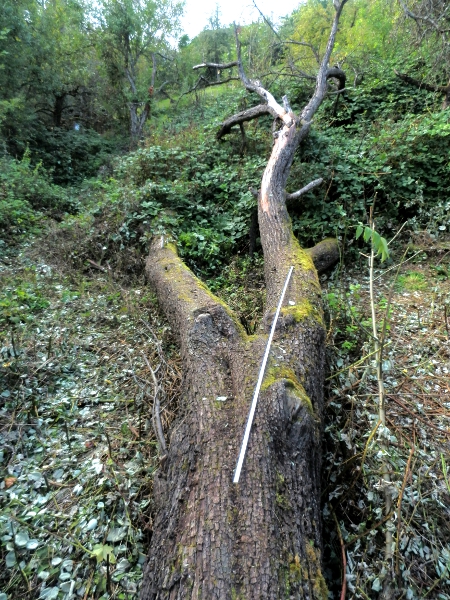
This tree inconsiderately fell over on the bit of ground that I want to site the Yurt. I'm glad it happened now and not after the Yurt was in place, but removal is proving tricky as it is at the bottom of a very steep hill with no road access. To give an idea of scale the white stick is 2m (6') long.

404-albums51-picture564.jpg


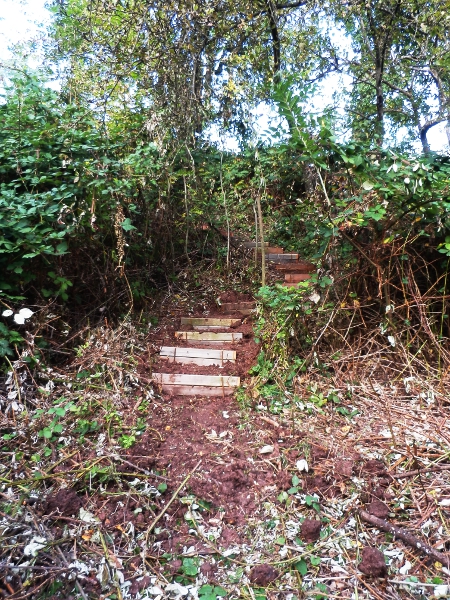
So here is what I've been doing: cutting and digging steps out so when I've finally managed to get someone with a chainsaw to cut the tree up, we can carry the remains out safely.

there's a more detailed version of the story here.


I'm also working on a compost WC so we can work here without having to use the bushes for calls of nature.

Getting there, indirectly and slowly, but we're getting there...
 
It's been while. Soon after I wrote the last post I was unable to work on the Yurt or indeed anything else due to health issues. The are fortunately now improving,and so are several other things:

With support from my college I graduated and I'm now qualified as acarpenter and working on a further qualification as an occupational therapist which ilvolves lots of woodwork and also working in coty farms and workshops for people with disabilities. This means I've gained a lot of skills, practiced my woodworking skills, and managed to get some contacts with people who won't automatically say I'm mad for even trying to build a Yurt, and who may even help out with a few things.

I also managed to get access to a room big enough to build the Yurt and still have space to work around it in the dry before building it outside.

So I have run out of excuses and I'm going to try again.

Right then...

So, I'm trying again.
 
Back
Top