Ad

Building my first yurt

ryankal

New member
Hello everyone,

I recently decided to leave the city life and am building a yurt on my aunts farm to get back to nature for a year or two. Im actually planning my trip to the lumber yard tomorrow to pick up the materials I need, and while doing some last minute research I came across this site.

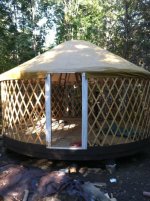
I am building a 12 ft yurt and have purchased my Tono, roof dome, roof and wall covers, insulation, door frame, and window frame from Hal at Laurel Nest Yurts. He was and continues to be very informative and really helpful. I am building my platform, khana, and rafters and will assemble it. I am sure I will have questions along the way, but I am hoping to receive a bit of input on some decisions I made due to my needs. As a fore warning, I don't do as well with precise instructions versus figuring things out as I go along.

First, I decided to design my platform with a large center post that is buried and set with stones below the frost line, but due to the size of my yurt and my relatively short stay, I don't plan on pouring deep footers for the rest of the support. I plan on using preformed concrete piers that are designed for a 4x4 post buried about a foot below grade.

(I live in Western MD and had minor concerns with frost heaving, so I decided to keep the platform about 1.5-2 ft above grade on a fairly level area. If I decide to stay longer I will likely move my yurt location and build a more permanent platform. I feel pretty comfortable with this and understand the issues this could present down the road.)

From the center post that I will have 2x8's going to the 4x4 posts set in the concrete pier. Between these I will have additional 2x8's as support braces. (I don't have a carpentry background so my terminology may be incorrect or unspecific) I have attached a diagram. Any thoughts or concerns here?


I was going to use 2x12's as my flooring, until I found Jafo's post regarding 2x6 TG. If I can find the TG in my area I will be using that. Otherwise I will use the 2x12's and apply a bead of silicone/caulk to increase the connection/weatherproofing between each board. On the outside of the 2x floor I plan on attaching a plywood band to act as an attachment for the khana. I will drill a hole in the plywood band which will connect to the khana at the lowermost hole.

Everything else I am planning is fairly standard in regards to the research I have performed. I hope my questions make sense and I wish I would have found this forum a month or so ago!!

Thank you for your time.

Regards,

Ryan

 

Attachments

  • photo.jpg
    photo.jpg
    91.6 KB · Views: 962
Re: Hello

I think your plan sounds fine, especially if this yurt will not remain for more than a couple years. Frost heaving can be a pain, but it is usually over several years. With a yurt that size, you can just level it back out should it heave much in the couple years you will be there.
 
Re: Hello

Thank you for the reassurance Jafo. Im sure I will have more questions as I construct my yurt, please bare with me.

Ryan
 
Re: Hello

FYI 2x12s from depot or lowes are gonna shrink big time. How much? Well if you butt them tight at install, six months later you'd be able to stuff a herd of cats into the gaps. :D

I suggest 2x6 if you go the 2X route. On my platform I installed 2x6 boards butted tight, and caulked gaps up to 3/8ths just a couple months later. The boards are still shrinking. I'll probablyhave to recaulk next summer. Lemme tell ya big gaps makes for a whole lotta cold blowin up yer pants legs this time of year. :D
 
Re: Hello

If you happen to opt for 2x6 decking, you might consider adding one or even two additional courses of co blocking for better support. 2' is normally the maximum span for 2x6.
 
Re: Hello

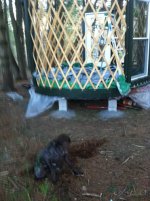
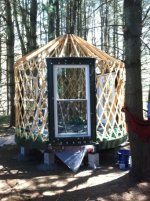
I own a 12 ft currently and admittedly spent too much on the platform. If I were to do it again for a semi-permanent (around 3 years or less) i would change a few things:

- use fewer posts. On my current yurt I used the pacific yurts downloadable platform plans which use around 12 posts. Next time I will instead dig four posts/ each at the edge of the largest sqaure which fits inside your 12 ft circle. I would then build a square wooden frame on top the four blocks and then frame my floor joists on top of that. this may be easier than one center post in the long run

- use 4x4 posts and concrete blocks set into the ground instead of concrete piers for a less expensive and more portable option

- if cost and portability is a concern it may be less expensive to purchase 3/4 in. 4x8 sheets T&G premium subfloor for $25 a sheet and simply paint the floor with a floor paint. Cut them into pizza wedge shapes so they are easily transported.

-
 

Attachments

  • photo 1.jpg
    photo 1.jpg
    99.4 KB · Views: 900
  • photo 2.jpg
    photo 2.jpg
    100.8 KB · Views: 795
  • image.jpg
    image.jpg
    20.6 KB · Views: 775
  • image(2).jpg
    image(2).jpg
    20.3 KB · Views: 897
  • image(7).jpg
    image(7).jpg
    19.6 KB · Views: 845
Re: Hello

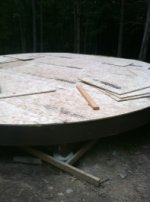
thanks bob, im really happy with how the double osb-lip turned out/ my friend came up with this, until then I had never seen it before...
 

Attachments

  • photo.jpg
    photo.jpg
    100.2 KB · Views: 846
Re: Hello

When it comes to dwellings, maybe one person in a thousand thinks outside the box of conventional construction. That's understandable and totally OK. It's a testament to just how good we have it here in the U.S., that so many take ownership of homes with central heat, full kitchens and baths with hot water, electrical power, and other amenities, dang near all are taken for granted.

However, one of the cool things about this site for me, is seeing and talking with others that think outside the box, at least on occassion. Not only do I like my yurt, but also tipis and other fabric structures like canvas wall tents, and tarps that are configured on the spot as necessary.

All I can say is, I love my yurt, and I can see why others that have experienced yurts have chosen to live in them full time. They really are incredible dwellings. Organic and close to the earth. Keeps yuz in touch with what's important and gives pause for contemplation of life and 'thinking outside the box', while staring at the wood stove fire.
 
Re: Hello

I really agree with Bob's post. Everyone in my family keeps asking why I didn't just get some lumber and build a rectangle cabin and I simply reply that I want to live in a circle. I still get a look of doubt when I explain more of the details. And I am positive that once they step inside my yurt (as long as it turns out at least close to my plans), that they will immediately understand.

Anyways, thanks for all the advice!

I hit the lumber yard today. My uncle is a homebuilder and he arranged for me to get some serious discounts through his supplier. Downside, the particular supply company keeps their wood outside, and we recently got hit with a lot of snow/ice, and I didn't feel quite comfortable hand picking wood for hours as they were more of a high volume company with forklifts flying around, even though I am sure I could have. So, I got more wood than I would need and should be able to make it work. Most of the wood looks good.

I decided to go 2x8 for the deck joists as well as for the flooring. They didn't have TG and the 2x8 looked better than their 2x6. I got 2x10 to rip for the rafters and khana.

I was considering just building the platform on concrete blocks, and at one point a square platform. I was even thinking of an earthen platform with a rocket mass heated floor at one point. As I already have the center post buried, so I'm going to stick with that unless I hit too many obstacles. Though I must say, ljamies, your ideas intrigue me.

My concern now, some of the wood has ice on it, Im sure some is a bit saturated with water. Should I allow it to melt/dry before working the wood? My thoughts are that, one I don't want to be cutting/ripping icy wood, two that I may encounter additional shrinking.

Thanks again everyone!

Regards,

Ryan
 
Re: Hello

My suggestion is to wait to resize the yurt stock. Shoving frozen boards with lumps of ice on them into a table saw is asking to get hurt. Ripping solidly frozen lumber to thin wall lattice size is a bad plan. Wet lumber is certainly OK to rip, but thin wall lattice size rips are gonna warp pronto, unless sawn from perfect stock. I wouldn't proceed with ripping yurt lumber at this time. Leave it banded and wait until the wood is well above freezing.

Go ahead and frame the floor and deck it. The sooner you get that floor framed and the deck boards screwed down, the less chance the lumber has to warp and take off on you. Sight the joisting and orient the crown up.

If you do wait, leave the lumberyard banding on it. That will help keep it straight. The mark of exhausted carpenters is lumber flopped down and kicked into a shabby pile at the end of the day. Look at the dregs of bunks of lumber in Depot or Lowes that the weekend warriors have torn through. Good for blocking and firewood. warp twist bow you name it.

BTW your wall lattice should ideally be ripped from the straightest grained, most knot free boards in your stock. Even small knots reduce the strength of narrow 2x rips to where they easily break.

If you consider waiting on the framing and deck until the lumber is above freezing, you might opt to prime the framing and back prime the decking. Also, look at the ends of the deck boards are orient the grain so the boards 'cup' towards the framing as they dry. Orient the end grain so it smiles at ya. :D Good luck.
 
Re: Hello

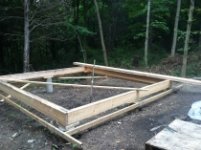
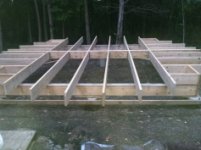
So, I am horribly indecisive. At least until I am fully confident in a decision. That said, I am changing my platform plans. I am going to build an octagon from 2x8, then add joists as necessary (two full length, then subsequent joists/blocks at 24 in). I will put my 2x8 flooring directly on this. I plan on resting this platform on cinderblocks. I will attach the platform to the cinderblocks by attaching 2x4 block to the cinderblocks with tapcons, then the platform to these wood blocks. I think this will be much simpler and more stable than my previous center post idea. Thank you ljamies for the ideas. I just need to wait for the weather to clear and ground to thaw.

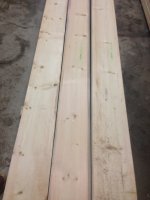
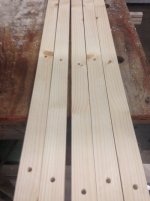
I set up the shed today to get into production mode. I ripped/drilled some khana as a test and am pleased with the results. However, none of my boards are completely clear. I took a couple photos of the boards and my results. The khana seem to be unaffected by the knots. Can you give me your thoughts?

Thanks!!

Ryan
 

Attachments

  • IMG_2612.jpg
    IMG_2612.jpg
    90.9 KB · Views: 723
  • IMG_2616.jpg
    IMG_2616.jpg
    91 KB · Views: 803
Re: Hello

To check before they go in the wall, gently flex and bend each lattice rip after the holes are drilled. If they don't break, use em. It's all a learning experience. Go for it. You're doing good. Keep it up.
 
Re: Hello

Also, I just reread your platform idea. Sounds good to me. Easy to disassemble in the future. The completed deck is going to be very heavy, and won't shift. Your yurt platform is gonna work fine. Butt the flooring 2x8s tight. Caulk the gaps as they appear. Enjoy building your yurt.
 
Re: Hello

Thanks! I plan on drilling then ripping. I can't imagine the extra work there would be if I ripped then drilled!

I have the platform partially framed, should have it finished tomorrow. Just trying to work around the weather.

I feel like I might be jumping ahead, but I am thinking stove installation. I have been thinking and researching this for awhile now, but haven't found the answers I need. I already have a stove, a Four Dog Stoves Two Dog, but with my goal of having my yurt up and complete by next Wednesday, I need to get on the ball. Im hoping that someone here can provide some insight.

1. Do I need to use double/triple wall chimney pipe? It is quite expensive and I am trying to save wherever I can. From my research it seems that it is needed to enhance the draw from my stove.

2. What should I use for a stove jack? I have been looking at that "silicone gasket patch". It seems sufficient.

3. If I go with the silicon patch, can I just use adhesive to install it? I don't have sewing skills, but I guess I can try to hand sew it in.

I plan on laying brick on the floor and setting the stove on that. I also plan on surrounding the stove with brick to act as a thermal mass and insulate it from the surrounding materials. Thoughts?

Thanks again everyone!!

Ryan
 
Re: Hello

1. Do I need to use double/triple wall chimney pipe? It is quite expensive and I am trying to save wherever I can. From my research it seems that it is needed to enhance the draw from my stove.

I used triple walled not because of draw, but because the pipe is so close to fabric. You really don't want to be inside a burning yurt.

2. What should I use for a stove jack? I have been looking at that "silicone gasket patch". It seems sufficient.

I used a standard through the wall kit and a flashing kit from Pacific Yurts.

I highly recommend going through the wall if possible. Use standard pipe until you actually go through the wall, then triple pipe the rest of the way. Expensive, but not as expensive as a funeral.

Here is a thread that might be helpful:

http://www.yurtforum.com/forums/building-a-yurt-f3/the-yurt-chimney-137.html
 
I hear you Jafo. I guess Ill have to bite the bullet.

I am having so much fun building this yurt, though, it is far more work than I imagined. I finished my khana today. Should have my rafters finished tomorrow. Might even be able to get my platform up and level tomorrow.

Thanks again everyone for their help and input!

Ryan
 
Back
Top