Ad

building a yurt for the winter...

I used 1.25" 1/4-20 carriage bolts and nylok nuts on my laths. I had washers between the laths to keep the painted laths from sticking, but that was a BIG mistake. No matter where I torqued the nuts, either the lath was too tight to open and close easily, or the washers rattled when it was windy. It was incredibly time consuming screwing around with the entire bolt system. As far as I'm concerned, the way to do laths is to tie them with cordage or rawhide. You know....just like the Mongolians do. They have yurt trad stuff figured out.
 
Also, nobody asked, but overlapping the lath sections and lashing them together top to bottom is ALSO the way to go. Similarly, if I built another trad yurt, I ABSOLUTELY would lash the door frame to the lath wall. That is WAY easier then trying to align the lath holes at the door and slide them over bolts set in the door frame. I have split more then one laths trying to get those holes over the screws. MAJOR PITA undoing the lath and redoing due to splits. Plus with the lath wall (khana) lashed to the frame you can adjust the yurt diameter somewhat by making the lath crosses diamonds, and still use the same yurt ring. Mongolians have this stuff all figured out. Lash. Don't bolt.

No opinion about rivets, I have never riveted anything, ever.
 
By the way my laths are 5/16ths thick.

A couple other points. If you opt for cordage, do 'NOT' > DO NOT!< use the cheapjack 1/8th or 1/4" low grade cheap crap cordage from Home Depot or Lowes or Walmart. I can't stress enough how lousy that stuff is. The mantle falls apart or bunches /knots up immediately and the core is worthless crap. Yeah I'm very opinionated about that JUNK.

What you need is solid braid cordage, like for draperies. Do 'NOT' use filament core cord. SOLID BRAID, no core. Nuff said.
 
OK last point. It is good design to angle the side jambs of the door frame so the follow the curve of your yurt wall. This is another mistake I made. I suggest NOT making the jambs square to the door. That way the wall easily follows the natural curve at the door frame.

Learn by doin'. lol
 
OK last point. It is good design to angle the side jambs of the door frame so the follow the curve of your yurt wall. This is another mistake I made. I suggest NOT making the jambs square to the door. That way the wall easily follows the natural curve at the door frame.


We run a threaded rod through the center of the side posts of the door frame so that it can pivot. If you run the threaded rod long enough it can go right down through the platform and tie the whole frame into the platform which is very solid.
 
Thanks for the info on assembling the lath. I was thinking about using nails and bending them over. Does anyone have opinions on that?

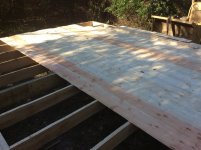
Here is my progress so far. The deck frame is complete and I milled pine boards and ship lapped them together. Next is cutting the boards into a circle then building a frame on top then I get to insulate and build another deck on top of that.. what fun!
 
Well the deck looks good enough. As for nails in the lath, I'd have to be pretty desperate to do that. Looking at hundreds of nails dangling on the inside, nah I'll pass on that. I probably have a phobia about bent nails being a carpenter and bent nails is a sign of rookie. lol Of course this is a different scenario but still....

If I were you I'd tie them. No way I'd use the 1.25" carraige bolts again. Next go round I'm tying mine.
 
Using cordage assures the wall won't be too tight. It will very easily expand to size, and easily fold up when you move. I've watched a number of vids of tied khana being opened. It looks like the wall could almost be tossed to expand it. Plus there is NO way the cordage will ever cause lath to crack. Those Mongolian know yurts very well.
 
Thanks guys,
I don't want dangling nails either. I was thinking about putting the heads on the inside. You make a good point about breaking the lath.

I didn't want to tie 2000 knots but maybe I should reconsider. As for bolts... way to expensive and time consuming for me. Lol
 
My concern with the nails would be ripping the wall fabric. What about rivets?

Traditional yurts use rawhide, but I understand they need to be replaced periodically so keep that in mind.
 
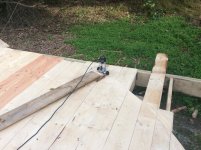
More work on the platform today. The base for the platform is finished. Next I have to cut 2x6's to make the platform. Lots of mill work.

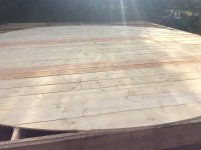
Here is my home made circle jig. It did a great job. Now I can get a feel for the finished space.
 

Attachments

  • IMG_0432.JPG
    IMG_0432.JPG
    206.9 KB · Views: 486
  • IMG_0433.JPG
    IMG_0433.JPG
    123.2 KB · Views: 461
Building the wall and assemblng hundreds of connectors takes patience. However what REALLY challenges that patience is finding out you screwed up and made them too tight, or that the washers rattle in the wind. I enjoyed building my yurt but tweaking all those bolts, and especially pulling hundreds of washers, and cracking some laths in the process, now that part just wasn't any fun at all. If your laths are thicker than 5/16ths you are less prone to breaking them.

If I was doing this again, I'd use 1/2" or thicker laths, and steam bend them. Tying with cordage is the way to go. Quiet in wind, plenty tight, strong enough, easy to fold and unfold, and easy to replace if necessary, wall erected or down.

Initially I built my yurt with perfection in mind. I wanted it on the money, everywhere. Perfectly tight wall, taught cable, no roof flex, everything exacting, because that's the way I am. But in fact it IS a tent. Tying works fine. I now know yurts don't even need a cable. A rope around the perimeter would be just fine, just like they do in Mongolia. Those folks really do have this stuff all figured out.
 
There are a few Youtube videos of Mongolians assembling their traditional nomadic-not Americanized- yurts. They aren't pulling wrenches to assemble anything. The entire tent is tied/lashed, including the ring supports (bagana) to the ring. If I was doing this again, I'd go Mongolian. Tie the lath crosses, lash the wall sections together, lash the door to the frame, and tension with a rope, or cloth band. Plenty good enough. Running threaded bolts through skinny laths, not so red hot. Live and learn.

You're doing good. Keep it up.
 
There are also photos and video of Mongolian yurts that are made with pole rafters, and shoot/ sapling walls. I'm no yurt scholar, but in my estimation, the first yurts were made with local materials requiring no machinlng or machined precision. Yurt walls, rafters, door was all natural materials, and all bound with cordage or rawhide. Todays Americanized yurts as as different from that as ilf carbon limbed olympic bows are from selfbows and self arrows tipped with knapped heads.
 
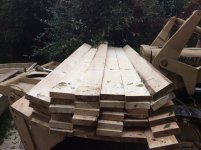
I finished milling the 2x6's for the floor joists. 5 logs gave me over 400 running feet of lumber. Next is the layout...
 

Attachments

  • IMG_0438.JPG
    IMG_0438.JPG
    114.3 KB · Views: 607
Back
Top