Ad

A hole in the Roof

Dan R-M

New member
Hey all!
The brief story of our new yurt is on my blog, so I won't go into great detail about the back story. It's a second-hand Spirit Mountain Yurt, and was cheap for good reason (as anyone familiar with SMY will recognize).
We've got a large number of holes in the vinyl roof, most of them in one quarter. Some of them up to 12 inches long, some that are multiple smallish holes in about a half a square foot section.
I used a pool patching kit to hit the big holes before putting the roof up, but it didn't work completely. Then there are aaaaaall the other holes...
I'd welcome any creative ideas! Especially if you have reason to believe they work.
 
Could you tell me what is causing the holes or is that part of the mystery? Sorry to hear you are having a hard time, let's see what we can figure out! :)
 
Oh, definitely part of the mystery :) My guess, though, is that they were a product of the collapse this yurt sustained. The original owners had bought three SMY's, and all three fell in a "dry hurricane" that we had in the area in 2008 (I think it was).
So I'd imagine the roof rafters/wall top/miscellaneous hardware/furniture scraped the roof up on its way down. The wall broke also, so there were plenty of pointy bits there.
That's all to say they likely happened all at once, and it won't be an ongoing problem.
 
I read the article about this on your blog (nice page btw!) and I see you talked with Pacific Yurts (PY). Definitely a good move because they are VERY knowledgeable.

A couple things.. When we got our roof from PY it came in a bag that was made out of the same material, and you can actually use the bag as patching material for the roof. I am not sure if Spirit did the same?

Are we talking thousands of holes here or just a few? I think if it is only a few then probably you just have to tough it out and patch each one. I am not sure how much snow you get there, but I would imagine some right? I would make sure you trim the patches neatly after they are applied just so snow and ice don't hang on them.

Second, did you ask PY if you could fit one of THEIR roofs on your Spirit yurt? They may not be able to guarantee it the same way, but it may actually fit.

Are you living in the yurt or just using it for recreation or other?
 
Thanks!
I wish they had - that would have been handy. When we bought our second-hand there were no bags involved, just tossed it in the truck.
On PY's order forms they note "Pacific Yurts does not provide parts for structures that we did not manufacture", and they ask if you are the original owner and, if not, what the name of the original owner is. Which I can understand.
There probably aren't more that a hundred little holes, some of them bunched nicely together. It wouldn't take more than 7 pool-patch kits :) Part of the difficulty now is that the roof is up, and some of the holes are crinkled from where they meet the wall. And, of course, some are pretty far up, but I'm not so worried about that.
I found a vinyl patch kit here, and wonder if that would do the trick, and if perhaps I might just do that from the inside.
An overarching question, though, is about degradation from UV light. Is all vinyl equal in terms of UV stability? And heat and cold tolerance? Depending on how it turns out, I may just go about doing yearly patching.
We'll be living in it all summer till it gets cool enough and the garden slows down enough that we can feel good moving back to the house.
 
I think that patch will work but you have to make sure the patch is on top of the roof, otherwise water will pool and any weight in there would probably tear the patch.

As for the vinyl, this is a tough call. With PY, when you upgrade to the vinyl side walls it is mostly for UV protection according to sales.. From what I have read about vinyl, there is nothing inherently UV protective in it, it is what they add to it that adds UV protection, such as certain pigments, etc..

If I had to guess, I would think it would be UV resistant or why go to a more expensive material than polyester?

In the end, I think the only way to find out for sure is to pose as a buyer at Spirit and ask them if the vinyl roof is UV resistant.
 
Well, I was thinking more in terms of the UV resistance of the patch material. If the roof isn't up to the solar wear, well, it would just be a matter of time before it's sunk.
 
Well, I was thinking more in terms of the UV resistance of the patch material. If the roof isn't up to the solar wear, well, it would just be a matter of time before it's sunk.

Ahh sorry, must have read that wrong. I would imagine that once the patch cured it would be set for a while. The sealant is meant to be used for outdoor applications so I am sure they probably took that into account.

Let us know how it turns out!

:)
 
Ok, I'm thinking silicone caulk now. I'm thinking I could just squirt it through the hole from below and smear it across the top where it comes through to make it smooth.
Of course, there's no real rush, because it seems it's never going to rain again...
 
I think silicone would work though I would test it on a piece of the fabric first. It doesn't stick to EVERYTHING lol and acetic acid is a byproduct of it which is why you smell vinegar when using it. Just test it on a spot first before going all out.

It has been my experience that silicone eventually loses a lot of it's elasticity over time, but that is probably the case with any compound you use to patch. I just am not sure how much UV accelerates that, if at all..

Please, do let us know how it works out. This is something that could come in handy to many yurt owners!
 
I certainly will - one friend has already told me that caulk is his solution to practically everything, so I'm optimistic...
 
Yeah, I caulked it about three weeks ago. If it would only rain, I could see how it held! We did have that massive windstorm two weeks ago, and that dropped .6" of rain in an hour. I believe the caulk worked, but there were so many other places the rain came in between the roof and wall (a post planned for another day) that it's hard to tell for sure.
Considering the extreme wind, I'm pleased that only two rafters fell out, and those were two that had not yet been fully secured.
When I can be sure about the caulk I'll let you know :)
 
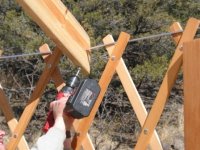
I missed the boat on this one, but... Is the roof material DuroLast ? That's what most yurt manufacturers use today, or a vinyl. If that's the case, then you're best friend in this situation is a product known as H-66. It literally melts and welds two pieces of vinyl together. You can get scrap pieces from any number of yurt manufacturers - Though probably not Pacific. With that many holes, the solution that will hold up the best is probably a complete patch over a large area, so paint on the H-66, be sure to let it air for about 30 seconds, then smooth on a patch. It should be done on the shiny side only of the DuroLast. UV is usually a killer on caulk... As for your rafters falling out, get a drill and some cable and zig zag it through drilled holes in the rafters. That way if one falls out, it won't hurt/maim/kill one of you. brackets securing the rafter to the ring are always a good idea too. Sounds like you don't have to worry about much snow or rain, but definitely the wind!
 
Hey, great ideas!
I'll look into procuring some scraps and H-66, though for the time being I'll see how the caulk weathers. 'Cause if it's a matter of only applying it once a year even, it wouldn't be too much trouble.
Time will also tell if this roof is worth it. There may end up being a large number of small holes throughout, depending on what all the little lighter spots are.
I hadn't thought about doing the zigzag cable for ours... Our friends' yurts have them, and the PY manual definitely describes them, so maybe that's a next step.
Wind is not usually a problem, but all it takes is once every couple years or so, you know?
 
I have that cabling on mine. It doesn't take much to do. Another thing Pacific Yurts does (not sure about the rest) is that they have a hole pre-drilled at the bottom of the rafter, right underneath the notch that you can drive a screw in, making it harder for the rafter to slip off the cable. Here is an image illustrating what I mean:

rafter.JPG
 
Ok, it rained nice and gentle for me. There are still some holes, though fewer than before.
There's evidently a spot at the center that leaks, too, between the dome and the roof. The compression ring has dropped some water on the floor, so I guess I'll bust out the caulk on that, too. I need to be out in it during the storm to identify the holes and the center leak.
I looked up the h-66. It mentions a list of applications from awnings to footwear to oil booms. That's the stuff for me! It looks like it's only for sale online, would that be accurate? Not a Lowe's/Home Depot/Ace Hardware kind of thing?
 
Yes, it only takes once!! And your yurt has already had some misfortune, Dan. I suspect that the reasons the Mongolians started keeping the center posts up even after set up was a situation like that... someone got hurt by a falling ring or something. I was talking about that with Becky Kemery at some point. She has another yurt blog and wrote the book, Yurts: Living in the Round.

H-66 is definitely not a Home Depot/Lowe's thing. :D Online is the way to go. Sorry to hear about the leaks... nothing dampens my yurt spirits quicker than a leaky yurt :( But at least you're in a dry climate!

The rafter locking screws are great. Colorado yurts do a sunken bolt/stainless steel 'cable catcher' at the end of their rafters. Love them. And then they also do the CORR bracket system, which is something I think every yurt should have, period. Then, no matter how that yurt may rock and roll, your rafters aren't coming out from the top or the bottom. The CORR bracket is in place of the peg at the end of the rafter that goes into the roof ring. It's a double sided bracket that slips over the end of each rafter, and a bolt goes through the rafter and bracket.
 

Attachments

  • yurt_dome_lifter.jpg
    yurt_dome_lifter.jpg
    16.8 KB · Views: 1,198
Back
Top