Ad

Platform ideas?

Jafo,
How did you do your concrete footings?

My contractor friend spend a day there with his trackhoe and put a bunch of hard fill where the platform was going to go and compacted it. Then he drove rebar 5' down into the fill and centered the top of the rebar through some footer block. He then filled the block with cement. So far no heaving, but will know more in the Spring. He guaranteed it for 10 years.
 
I used the pacific yurts design and the piers sit on the ground--not below frost.
I have had the yurt 3 years now and no heaving.
I think if I did it over again I would put in piers/sonotubes below frost line(4' where I am)
and the 2x10's 2' apart not 4' apart~ especially if you are planning on year round living.
But then I would also consider earthen floors rather than wooden ones ~ although I do like my wide pine floors.
Corina
 
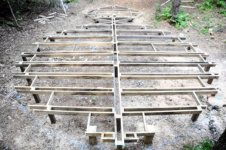
Frame and Floor for: Walk-through 10 Foot Yurt entrance into 20 Foot Yurt with 32" Entrance door and 32"X48" double-hung vinyl window.
 

Attachments

  • platformpic1web.jpg
    platformpic1web.jpg
    102.6 KB · Views: 1,274
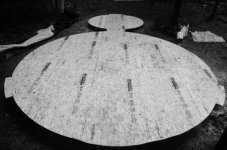
  • Platformpicwithadvantechcutout2013web.jpg
    Platformpicwithadvantechcutout2013web.jpg
    97.2 KB · Views: 1,212
I know this is not exactly a platform idea, but it might be of interest for the group.

It may have been posted here before, but I didn't find it with the search so I will put it out here for your reading pleasure, (perhaps again).

Tamped Earth Floors

Good step by step information about making rammed earth floors. Cheap and beautiful, but perhaps a bit time consuming.

He mentions specifically in this article that you can also include pipe in the sub-layers of the floor if you wanted to do a radiant heating system in this floor. Just keep it away from the gravel to avoid a possible puncture.

If I was going to make a radiant heated floor in this manner, I would be sure to have a thermal barrier below it, and around the edges to "keep my heat".

I got this from an article about earthbag building, and they specifically talked about creating a yurt foundation using earthbag style construction.

This is not the website I was reading, but there is lots of good information here: Earthbag Building Index

If I can find the one I read I will be sure to pass it forward too.

Rod
[email protected]
 
He mentions specifically in this article that you can also include pipe in the sub-layers of the floor if you wanted to do a radiant heating system in this floor. Just keep it away from the gravel to avoid a possible puncture.

If I was going to make a radiant heated floor in this manner, I would be sure to have a thermal barrier below it, and around the edges to "keep my heat".
I agree. Getting that mass up to temperature might take quite a bit of energy, so I wouldn't want to lose it.

I got this from an article about earthbag building, and they specifically talked about creating a yurt foundation using earthbag style construction.

This is not the website I was reading, but there is lots of good information here: Earthbag Building Index

If I can find the one I read I will be sure to pass it forward too.
I am planning to do an earthbag yurt foundation/basement so if you do find the article, please post! :)

Thanks for the info.
 
This is still not the blog I was reading, hahaha, but I found it while I was looking for it. Once again, lots of good stuff here, if you are so inclined, and your site is not so inclined. I know, bad pun.

Insulated Earthbag Foundations for Yurts

Give it a look Dan, Might have the information you need.

In one of his post from 2011 the writer is talking about a book he is about to publish. I don't have time to look it up now, but you might try, and let everyone know if you can find it.

Have a good morning, but I will be sleeping. 12 hours ahead of EST here. Got to walk the dog and hit the hay.

Rod
rod::email::yurtlocker.com
 
Thanks Rod.
I think this is the book you are talking about: Earthbag Building Guide by Owen Gieger.

Here are some 'similar' examples of what I'm planning to do (eventually).
Roundhouse with Yurt

Smiling Woods Yurt with basement

In the second example above, imagine the basement portion being of earthbag construction.

I am messing around in Google Sketchup trying to figure out how I will be doing the basement ceiling/yurt floor. For a 30' yurt, if I go with a center support column and do radial joists, that puts a 4' distance between joists at the radius (edge of the yurt). That seems far (when compared to typical 16" or 24" spacing), but the yurt deck plans I've seen basically have 4'x4' spacings between supports and using 1 1/8" plywood so I think what I'm planning would be fine. The spacing between joists of course gets smaller the closer to the center of the yurt you get (to the point where they would actually touch).
Another option would be for me to build the earthbag basement with a dividing wall that passes through the center and then lay out joists similar to what I've seen in yurt deck planning, i.e a rectilinear grid, with the dividing wall and the round wall providing support for the joists. This method, obviously, will split the basement into at least 2 sections (good or bad, I haven't decided, haha).

I'll toss some sketchups on here when I get them done.
 
I've been considering a hard-sided yurt home, and I'd like to put it on a full basement. Most of the designs for the basements I've found are divided rooms with load-bearing walls that reach the center of the circle. I'll be living in this thing full-time with my lovely suburban wife, so 'we' would like to have a laundry room, guest room, and storage area along with a game room down in the basement, with a walkout on one side. As long as you aren't fretting over room division, a poured or blocked load-bearing wall through the center of the space would handle potential support issues.
 
@camptc:

I really don't want to be a naysayer, but unless you really, really know what you are doing you might want to reconsider. "Putting in" a full basement on which you plan to place a residential floor structure (to support appliances for living full time) is a whole lot different from building a deck platform off the ground and putting a yurt on it.
Our preliminary yurt plans include a separate 8x12 converted shed structure to house a shower and washer-dryer. But when you mention having a separate game room, storage room, guest room...you really ought to consider buying a house. My guess is it will be better and cheaper in the long run, for what you are contemplating. And if your wife wants to live in the suburbs, buy a place in the suburbs.
Again, I don't mean to be a naysayer but...the Gods of the Copybook Headings are cruel masters.
 
Hello everyone.
I am new to this forum and gain quite a bit of knowledge here. I am in my planing stage and looking for cost effective solution for my 6m Yurt base. I already excluded wooden decks since it's out of my budget to build and against the zoning where I want to set it up. "No permanent structure allowed." So for now the only one I consider is straw bales since it's cheap to buy and easy to install. I also have an idea that I wanted to share with you.

I have a question for you guys. Bear with me, since I don't have construction knowledge whatsoever. My ancestors set their yurts directly on the ground year round. I have heard bad stories though about moisture in the fall and early spring. I have an idea that I think could work to keep the yurt dry on bare ground.

First to dig a trench around the yurt perimeter (maybe a foot by foot?), set up a weed tarp on the place where yurt will stand including the trench. Fill the trench with pebble stones. Then put another tarp and fold the sides around the walls and then proceed with yurt set up. So I hope that during the rain the trench will capture water and stream it away from my yurt. Insulation will be achieved by foam mats and carpets.

What do you think?
Kochevnik
 
I'd install the yurt atop a cheap blue tarp that was at least two feet wider than the yurts diameter. Get the tarp in place atop the bales or whatever. Erect the yurt. Fold the tarp edge up the outside of the lattice wall and under the cover. The lowest tension rope will keep the tarp snugged to the wall.

There you have a bathtub floor. No bugs no water no drafts. I've seen this done by a young nomadic couple with a 6M yurt in a youtube video. There yurt was on the ground. Looks to be a very good cheap way to protect the carpet lino or whatever you cover the floor with. Good luck.
 
Thank you Bob. That's definitely my solution for now.

By the way. I am working on my personal blog where I will be posting lots of information about central asian customs, traditions, Yurts etc. Let me know if you have any questions about Turkic type of yurt.
 
Hey, does anybody out there have any experience with using straw bales as an under floor insulation method. I would lay old car tyres packed with earth on the leveled ground and then a layer of 13mm chicken mesh. Sit the bales on top and wrap the bales in chicken mesh to stop any vermin nesting and then using cargo straps with a ratchet, would tighten the whole assembly nice and tight. Then with a light wooden frame on top of that fit my marine plywood as my base. This is my plan, l would very much welcome any constructive criticism. Thanking you in advance, Jonathan.
 
I have no idea how well this sort of base would work, but I personally would plan to include multiple tie-down straps over the yurt. And what would keep the straw from decomposing? I know one can build straw bale homes, but I think they have a coating and maybe no compression directly on the bales? I'm all for experimenting! Though smart you are crowd sourcing your ideas. Looking forward to others weighing in. Good luck, Jonathan! :)
 
Back
Top